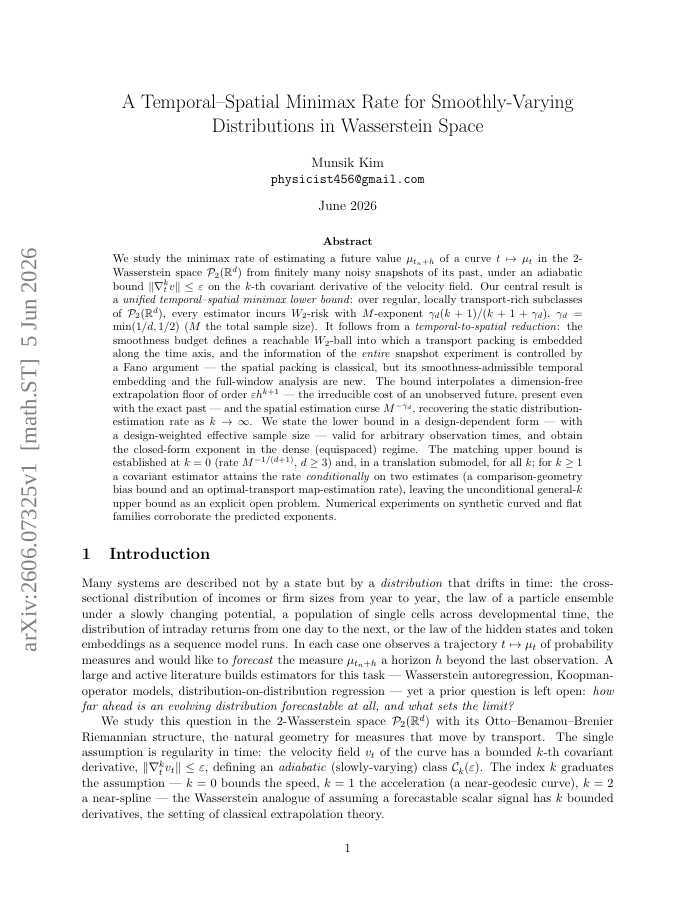
We study the minimax rate of estimating a future value μ_{t_n+h} of a curve t\mapstoμ_t in the 2-Wasserstein space P_2(\mathbb{R}^d) from finitely many noisy snapshots of its past, under an adiabatic bound |\nabla_t^k v|\le\varepsilon on the k-th covariant derivative of the velocity field. Our central result is a unified temporal-spatial minimax lower bound: over regular, locally transport-rich subclasses, every estimator incurs W_2-risk with M-exponent γ_d(k+1)/(k+1+γ_d), γ_d=\min(1/d,1/2) (M the total sample size). It follows from a temporal-to-spatial reduction: the smoothness budget defines a reachable W_2-ball into which a transport packing is embedded along the time axis, and the information of the entire snapshot experiment is controlled by a Fano argument -- the spatial packing is classical, but its smoothness-admissible temporal embedding and the full-window analysis are new. The bound interpolates a dimension-free extrapolation floor of order \varepsilon h^{k+1} -- the irreducible cost of an unobserved future, present even with the exact past -- and the spatial estimation curse M^{-γ_d}, recovering the static distribution-estimation rate as k\to\infty. We state the lower bound in a design-dependent form -- with a design-weighted effective sample size -- valid for arbitrary observation times, and obtain the closed-form exponent in the dense (equispaced) regime. The matching upper bound is established at k=0 (rate M^{-1/(d+1)}, d\ge3) and, in a translation submodel, for all k; for k\ge1 a covariant estimator attains the rate conditionally on two estimates (a comparison-geometry bias bound and an optimal-transport map-estimation rate), leaving the unconditional general-k upper bound as an open problem. Numerical experiments on synthetic curved and flat families corroborate the predicted exponents.
A Temporal Spatial Minimax Rate for Smoothly-Varying Distributions in Wasserstein Space
We study the minimax rate of estimating a future value $μ_{t_n+h}$ of a curve $t\mapstoμ_t$ in the $2$-Wasserstein space $\mathcal{P}_2(\mathbb{R}^d)$ from finitely many noisy snapshots of its past, under an adiabatic bound $\|\nabla_t^k v\|\le\varepsilon$ on the $k$-th…
- Preview
- Year
- 2026
- Hosting
- Full text hostedCC-BY-4.0
Cite
Notes
Only stored in your browser.
Attribution
- Abstract & full text
- arxiv.org/abs/2606.07325CC-BY-4.0
- TL;DR
- Semantic Scholar