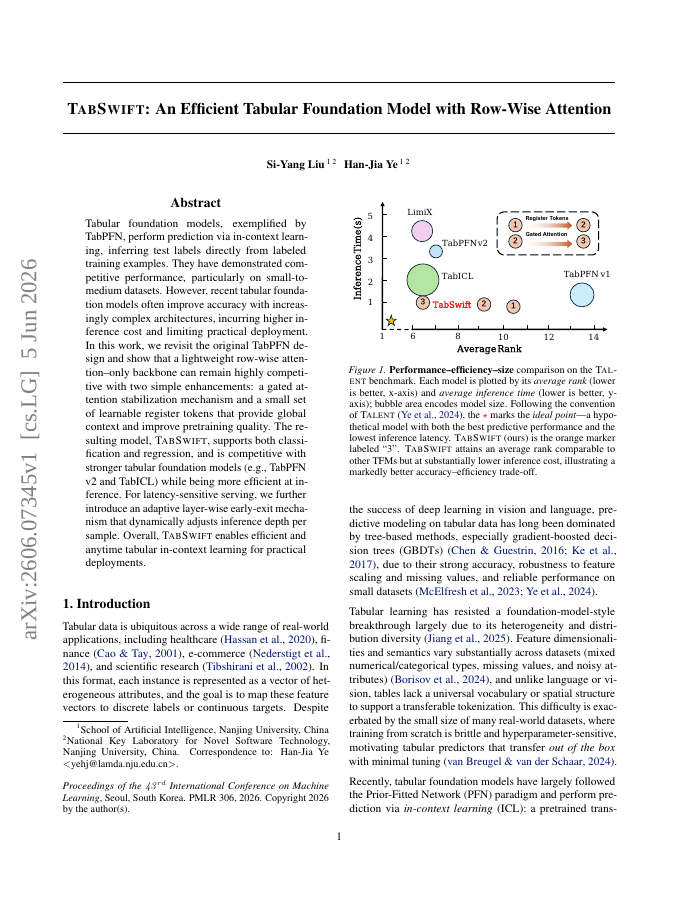
Tabular foundation models, exemplified by TabPFN, perform prediction via in-context learning, inferring test labels directly from labeled training examples. They have demonstrated competitive performance, particularly on small-to-medium datasets. However, recent tabular foundation models often improve accuracy with increasingly complex architectures, incurring higher inference cost and limiting practical deployment. In this work, we revisit the original TabPFN design and show that a lightweight row-wise attention-only backbone can remain highly competitive with two simple enhancements: a gated attention stabilization mechanism and a small set of learnable register tokens that provide global context and improve pretraining quality. The resulting model, TabSwift, supports both classification and regression, and is competitive with stronger tabular foundation models (e.g., TabPFN v2 and TabICL) while being more efficient at inference. For latency-sensitive serving, we further introduce an adaptive layer-wise early-exit mechanism that dynamically adjusts inference depth per sample. Overall, TabSwift enables efficient and anytime tabular in-context learning for practical deployments.
TabSwift: An Efficient Tabular Foundation Model with Row-Wise Attention
Tabular foundation models, exemplified by TabPFN, perform prediction via in-context learning, inferring test labels directly from labeled training examples. They have demonstrated competitive performance, particularly on small-to-medium datasets.
- Preview
- Year
- 2026
- Hosting
- Full text hostedCC-BY-4.0
Cite
Notes
Only stored in your browser.
Attribution
- Abstract & full text
- arxiv.org/abs/2606.07345CC-BY-4.0
- TL;DR
- Semantic Scholar