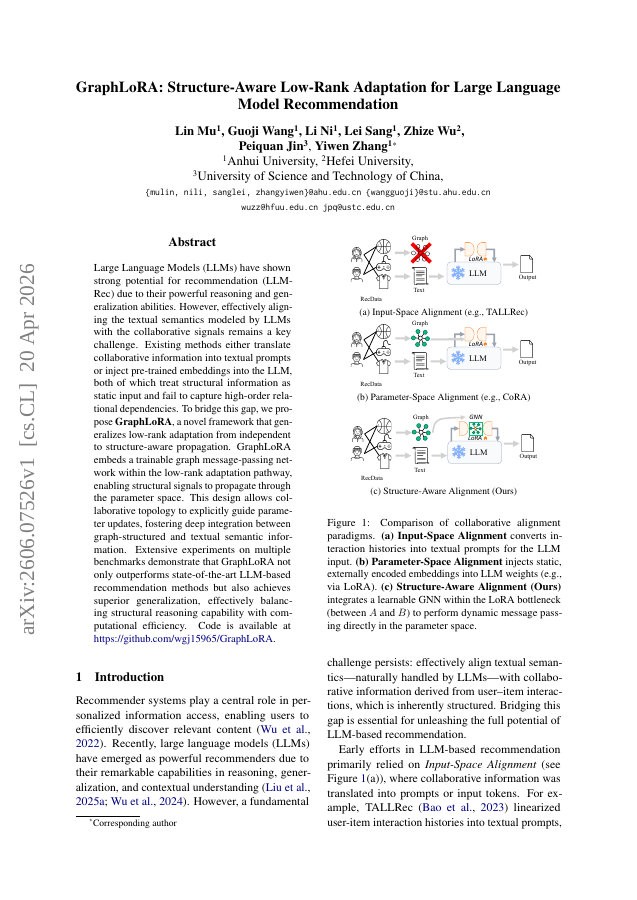
Large Language Models (LLMs) have shown strong potential for recommendation (LLMRec) due to their powerful reasoning and generalization abilities. However, effectively aligning the textual semantics modeled by LLMs with the collaborative signals remains a key challenge. Existing methods either translate collaborative information into textual prompts or inject pre-trained embeddings into the LLM, both of which treat structural information as static input and fail to capture high-order relational dependencies. To bridge this gap, we propose GraphLoRA, a novel framework that generalizes low-rank adaptation from independent to structure-aware propagation. GraphLoRA embeds a trainable graph message-passing network within the low-rank adaptation pathway, enabling structural signals to propagate through the parameter space. This design allows collaborative topology to explicitly guide parameter updates, fostering deep integration between graph-structured and textual semantic information. Extensive experiments on multiple benchmarks demonstrate that GraphLoRA not only outperforms state-of-the-art LLM-based recommendation methods but also achieves superior generalization, effectively balancing structural reasoning capability with computational efficiency. Code is available at https://github.com/wgj15965/GraphLoRA.
GraphLoRA: Structure-Aware Low-Rank Adaptation for Large Language Model Recommendation
Large Language Models (LLMs) have shown strong potential for recommendation (LLMRec) due to their powerful reasoning and generalization abilities. However, effectively aligning the textual semantics modeled by LLMs with the collaborative signals remains a key challenge.
- Preview
- Year
- 2026
- Hosting
- Abstract onlyARXIV-DEFAULT
Cite
Notes
Only stored in your browser.
Attribution
- Abstract & full text
- arxiv.org/abs/2606.07526ARXIV-DEFAULT
- TL;DR
- Semantic Scholar