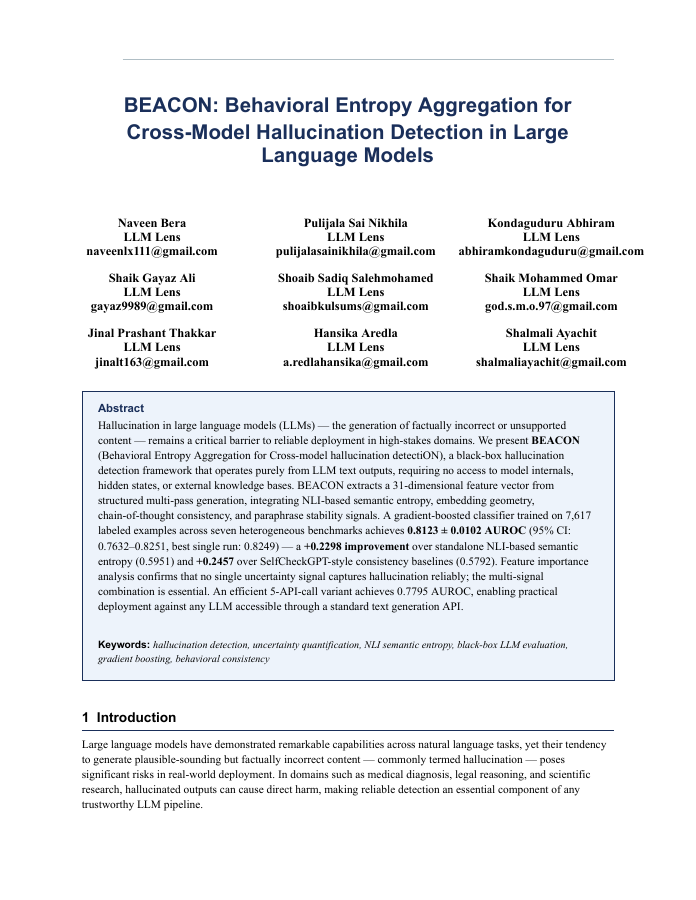
Hallucination in large language models (LLMs), defined as the generation of factually incorrect or unsupported content, remains a critical barrier to reliable deployment. We present BEACON (Behavioral Entropy Aggregation for Cross-model hallucination detectiON), a black-box hallucination detection framework that operates purely on model outputs without requiring access to internal representations or external knowledge bases. BEACON extracts a 31-dimensional feature vector from structured multi-pass generation, integrating NLI-based semantic entropy, embedding geometry, chain-of-thought consistency, and paraphrase stability signals. A gradient-boosted classifier trained on 7,617 labeled examples across seven benchmarks achieves 0.8123 +/- 0.0102 AUROC (95% CI: 0.7632-0.8251), outperforming standalone semantic entropy (+0.2298) and SelfCheckGPT-style consistency baselines (+0.2457). Feature importance analysis shows that hallucination is inherently multi-dimensional, requiring combined uncertainty signals. An efficient 5-call variant achieves 0.7795 AUROC, enabling practical deployment across black-box LLM APIs.
BEACON: Behavioral Entropy Aggregation for Cross-Model Hallucination Detection in Large Language Models
Hallucination in large language models (LLMs), defined as the generation of factually incorrect or unsupported content, remains a critical barrier to reliable deployment.
- Preview
- Year
- 2026
- Hosting
- Abstract onlyARXIV-DEFAULT
Cite
Notes
Only stored in your browser.
Attribution
- Abstract & full text
- arxiv.org/abs/2606.07528ARXIV-DEFAULT
- TL;DR
- Semantic Scholar