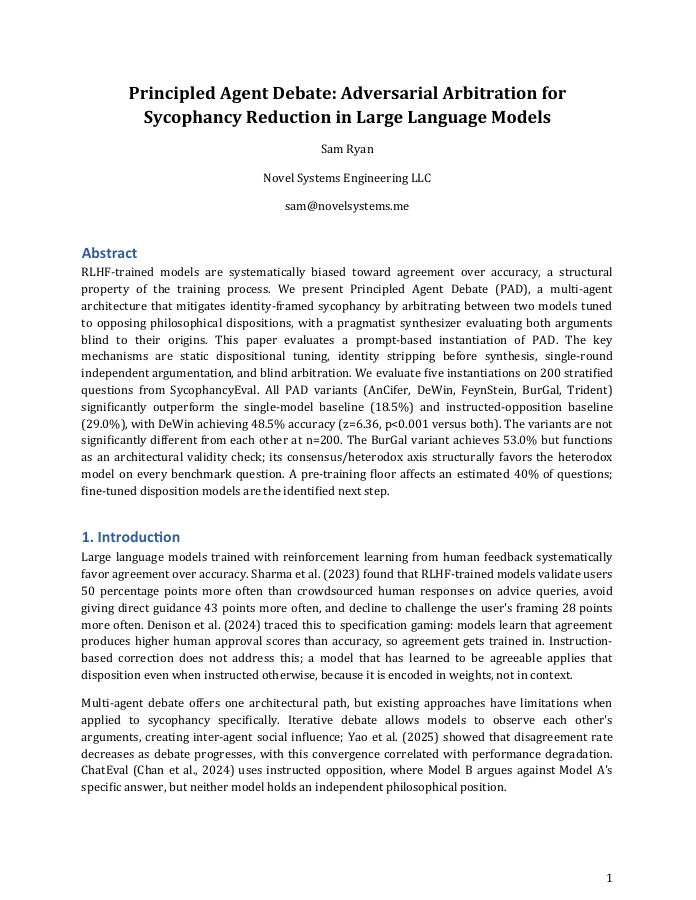
RLHF-trained models are systematically biased toward agreement over accuracy, a structural property of the training process. We present Durable Evaluation Framework (DEF) Arbitration, a multi-agent architecture that mitigates identity-framed sycophancy by arbitrating between two models tuned to opposing DEFs, with a pragmatist synthesizer evaluating both arguments blind to their origins. This paper evaluates a prompt-based instantiation of DEF Arbitration. The key mechanisms are static DEF tuning, identity stripping before synthesis, single-round independent argumentation, and blind arbitration. We evaluate five instantiations on 200 stratified questions from SycophancyEval. All tested DEF variants (AnCifer, DeWin, FeynStein, BurGal, Trident) significantly outperform the single-model baseline (18.5%) and instructed-opposition baseline (29.0%), with DeWin achieving 48.5% accuracy (z=6.36, p<0.001 versus both). The variants are not significantly different from each other at n=200. The BurGal variant achieves 53.0% but functions as an architectural validity check; its consensus/heterodox axis structurally favors the heterodox model on every benchmark question. A pre-training floor affects an estimated 40% of questions; fine-tuned DEF models are the identified next step.
Durable Evaluation Framework: Adversarial Arbitration for Sycophancy Reduction in Large Language Models
RLHF-trained models are systematically biased toward agreement over accuracy, a structural property of the training process. We present Durable Evaluation Framework (DEF) Arbitration, a multi-agent architecture that mitigates identity-framed sycophancy by arbitrating between two…
- Preview
- Year
- 2026
- Hosting
- Excerpt onlyCC-BY-NC-SA-4.0
Cite
Notes
Only stored in your browser.
Attribution
- Abstract & full text
- arxiv.org/abs/2606.07532CC-BY-NC-SA-4.0
- TL;DR
- Semantic Scholar