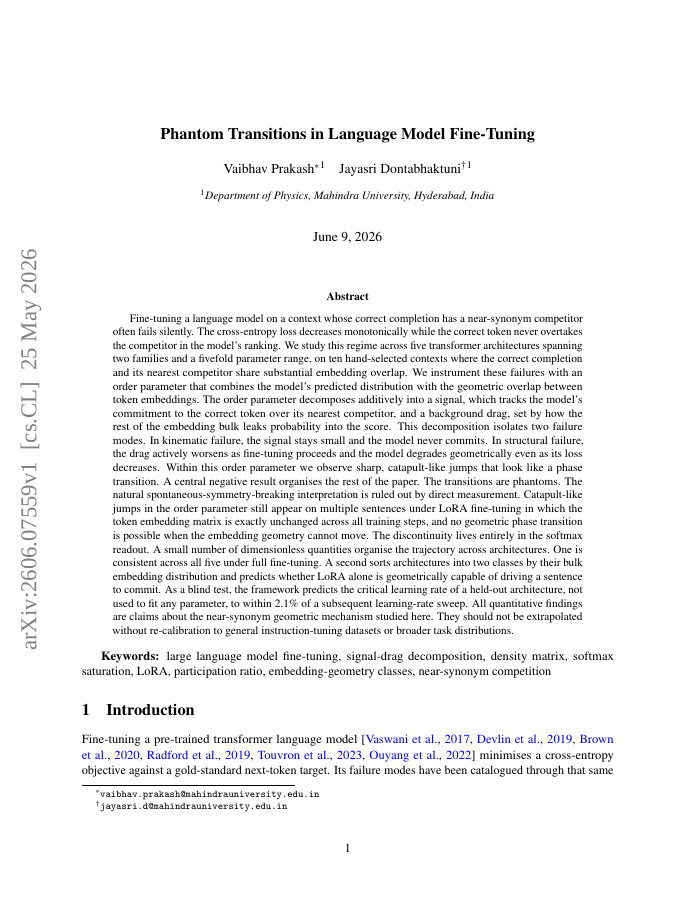
Fine-tuning a language model on contexts whose correct completion has a near-synonym competitor often fails silently. The cross-entropy loss decreases monotonically while the correct token never overtakes the competitor in rank. We study this regime across five transformer architectures spanning two families and a fivefold parameter range, on ten hand-selected near-synonym contexts. We instrument these failures with an order parameter combining the predicted distribution and pairwise embedding overlaps. It decomposes additively into a signal, tracking the model's commitment to the correct token over its nearest competitor, and a background drag, set by how the embedding bulk leaks probability into the score. This isolates two failure modes. In kinematic failure the signal stays small. In structural failure the drag actively worsens as fine-tuning proceeds. We observe sharp catapult-like jumps in the order parameter that resemble a phase transition. A central negative result organises the paper. The transitions are phantoms. The spontaneous-symmetry-breaking interpretation is ruled out by direct measurement. Catapult-like jumps still appear under LoRA fine-tuning with the token embedding matrix exactly unchanged during training, where no geometric phase transition is possible. The discontinuity lives entirely in the softmax readout. A small number of dimensionless quantities organise the trajectory across architectures. One is consistent across all five under full fine-tuning. A second sorts architectures into two classes by bulk embedding distribution and predicts LoRA sufficiency. As a blind test, the framework predicts the critical learning rate of a held-out architecture, not used to fit any parameter, to within 2.1% of a subsequent learning-rate sweep. Findings concern the near-synonym mechanism only and should not be extrapolated without recalibration.
Phantom transitions in language model fine-tuning
Fine-tuning a language model on contexts whose correct completion has a near-synonym competitor often fails silently. The cross-entropy loss decreases monotonically while the correct token never overtakes the competitor in rank.
- Preview
- Year
- 2026
- Hosting
- Full text hostedCC-BY-4.0
Cite
Notes
Only stored in your browser.
Attribution
- Abstract & full text
- arxiv.org/abs/2606.07559CC-BY-4.0
- TL;DR
- Semantic Scholar