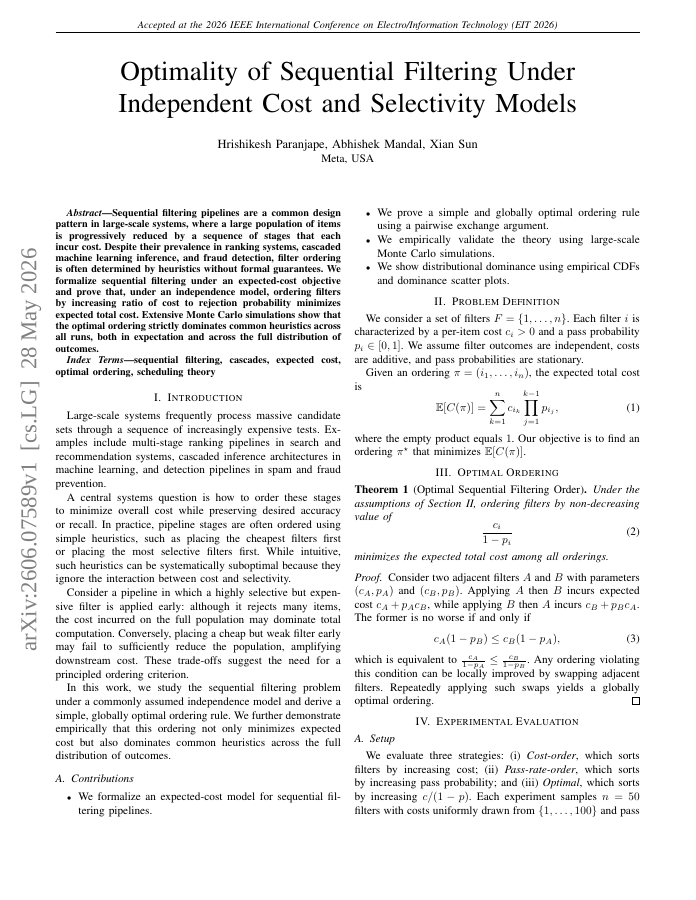
Sequential filtering pipelines are a common design pattern in large-scale systems, where a large population of items is progressively reduced by a sequence of stages that each incur cost. Despite their prevalence in ranking systems, cascaded machine learning inference, and fraud detection, filter ordering is often determined by heuristics without formal guarantees. We formalize sequential filtering under an expected-cost objective and prove that, under an independence model, ordering filters by increasing ratio of cost to rejection probability minimizes expected total cost. Extensive Monte Carlo simulations show that the optimal ordering strictly dominates common heuristics across all runs, both in expectation and across the full distribution of outcomes.
Optimality of Sequential Filtering Under Independent Cost and Selectivity Models
Sequential filtering pipelines are a common design pattern in large-scale systems, where a large population of items is progressively reduced by a sequence of stages that each incur cost.
- Preview
- Year
- 2026
- Hosting
- Abstract onlyARXIV-DEFAULT
Cite
Notes
Only stored in your browser.
Attribution
- Abstract & full text
- arxiv.org/abs/2606.07589ARXIV-DEFAULT
- TL;DR
- Semantic Scholar