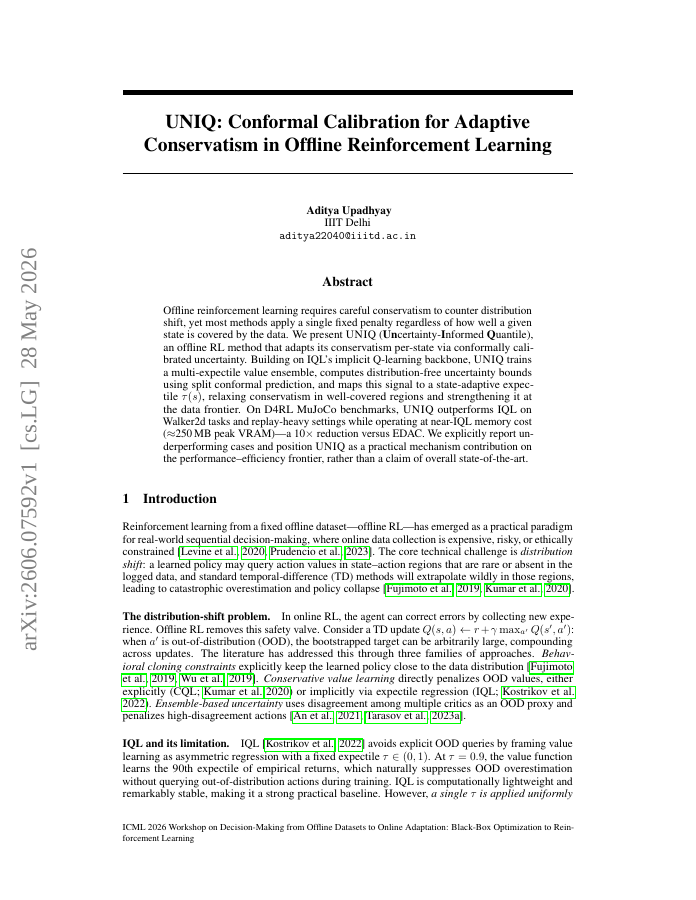
Offline reinforcement learning requires careful conservatism to mitigate distribution shift, yet most existing methods apply a fixed penalty uniformly across all states regardless of local data coverage. We present UNIQ (Uncertainty-Informed Quantile), an offline RL method that introduces state-adaptive conservatism through conformally calibrated uncertainty estimation. Built on the Implicit Q-Learning (IQL) backbone, UNIQ trains a multi-expectile value ensemble, computes distribution-free uncertainty estimates using split conformal prediction, and maps the resulting signal to a state-dependent expectile that relaxes conservatism in well-covered regions while strengthening it in uncertain regions near the data frontier. On D4RL MuJoCo benchmarks, UNIQ consistently improves over IQL, with the largest gains observed on Walker2d and replay-heavy tasks. At the same time, UNIQ operates at near-IQL memory cost (approximately 250 MB peak VRAM), providing roughly a 10x reduction compared to EDAC. Rather than pursuing overall state-of-the-art performance, we position UNIQ as a practical mechanism contribution that improves the performance-efficiency trade-off in offline reinforcement learning.
UNIQ: Conformal Calibration for Adaptive Conservatism in Offline Reinforcement Learning
Offline reinforcement learning requires careful conservatism to mitigate distribution shift, yet most existing methods apply a fixed penalty uniformly across all states regardless of local data coverage.
- Preview
- Year
- 2026
- Hosting
- Full text hostedCC-BY-4.0
Cite
Notes
Only stored in your browser.
Attribution
- Abstract & full text
- arxiv.org/abs/2606.07592CC-BY-4.0
- TL;DR
- Semantic Scholar