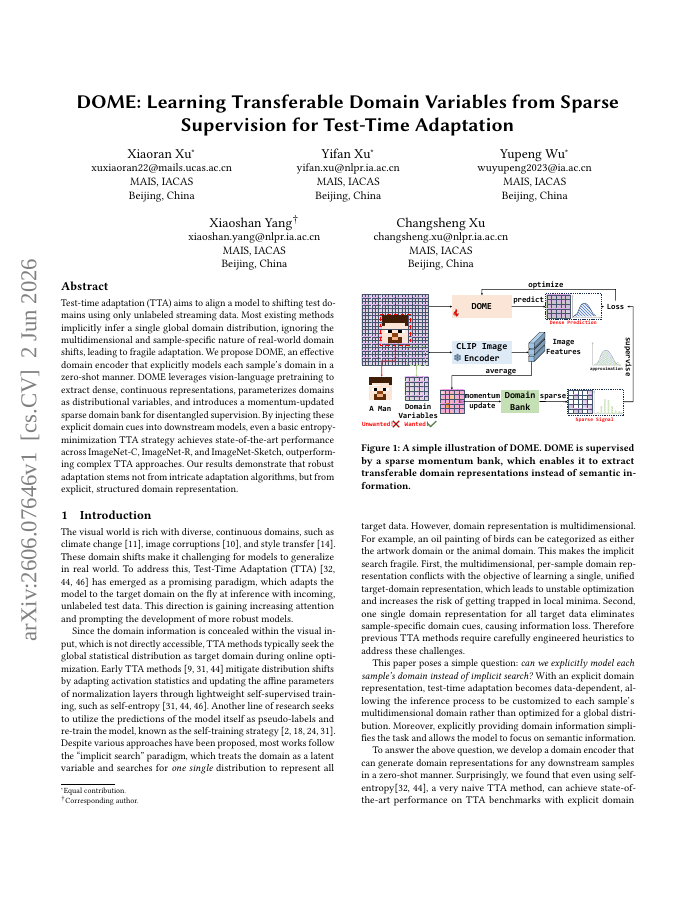
Test-time adaptation (TTA) aims to align a model to shifting test domains using only unlabeled streaming data. Most existing methods implicitly infer a single global domain distribution, ignoring the multidimensional and sample-specific nature of real-world domain shifts, leading to fragile adaptation. We propose DOME, an effective domain encoder that explicitly models each sample's domain in a zero-shot manner. DOME leverages vision-language pretraining to extract dense, continuous representations, parameterizes domains as distributional variables, and introduces a momentum-updated sparse domain bank for disentangled supervision. By injecting these explicit domain cues into downstream models, even a basic entropy-minimization TTA strategy achieves state-of-the-art performance across ImageNet-C, ImageNet-R, and ImageNet-Sketch, outperforming complex TTA approaches. Our results demonstrate that robust adaptation stems not from intricate adaptation algorithms, but from explicit, structured domain representation.
DOME: Learning Transferable Domain Variables from Sparse Supervision for Test-Time Adaptation
Test-time adaptation (TTA) aims to align a model to shifting test domains using only unlabeled streaming data. Most existing methods implicitly infer a single global domain distribution, ignoring the multidimensional and sample-specific nature of real-world domain shifts,…
- Preview
- Year
- 2026
- Hosting
- Full text hostedCC-BY-4.0
Cite
Notes
Only stored in your browser.
Attribution
- Abstract & full text
- arxiv.org/abs/2606.07646CC-BY-4.0
- TL;DR
- Semantic Scholar