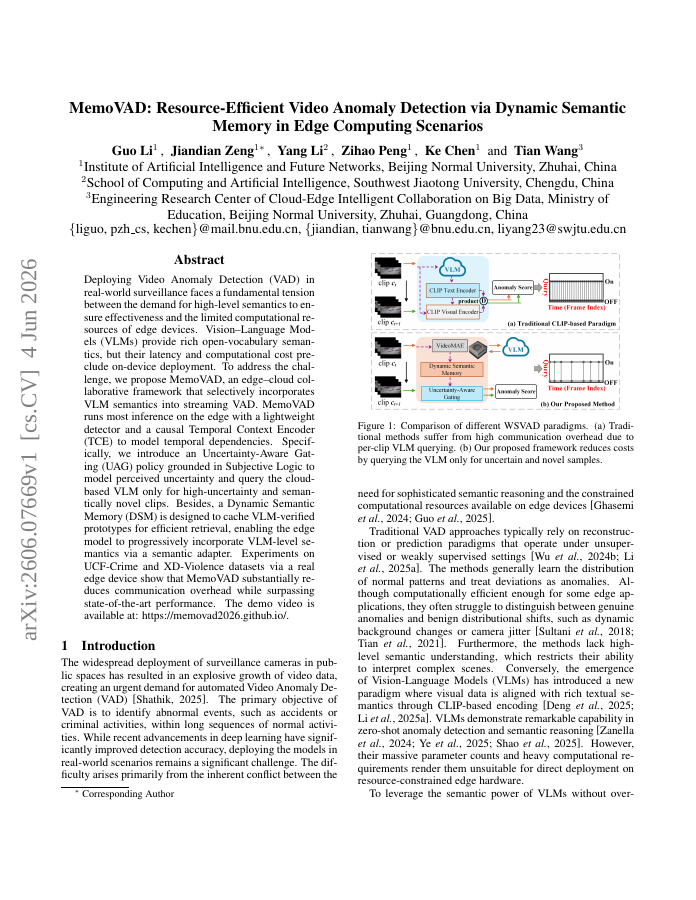
Deploying Video Anomaly Detection (VAD) in real-world surveillance faces a fundamental tension between the demand for high-level semantics to ensure effectiveness and the limited computational resources of edge devices. Vision-Language Models (VLMs) provide rich open-vocabulary semantics, but their latency and computational cost preclude on-device deployment. To address the challenge, we propose MemoVAD, an edge-cloud collaborative framework that selectively incorporates VLM semantics into streaming VAD. MemoVAD runs most inference on the edge with a lightweight detector and a causal Temporal Context Encoder (TCE) to model temporal dependencies. Specifically, we introduce an Uncertainty-Aware Gating (UAG) policy grounded in Subjective Logic to model perceived uncertainty and query the cloud-based VLM only for high-uncertainty and semantically novel clips. Besides, a Dynamic Semantic Memory (DSM) is designed to cache VLM-verified prototypes for efficient retrieval, enabling the edge model to progressively incorporate VLM-level semantics via a semantic adapter. Experiments on UCF-Crime and XD-Violence datasets via a real edge device show that MemoVAD substantially reduces communication overhead while surpassing state-of-the-art performance.
MemoVAD: Resource-Efficient Video Anomaly Detection via Dynamic Semantic Memory in Edge Computing Scenarios
Deploying Video Anomaly Detection (VAD) in real-world surveillance faces a fundamental tension between the demand for high-level semantics to ensure effectiveness and the limited computational resources of edge devices.
- Preview
- Year
- 2026
- Hosting
- Abstract onlyARXIV-DEFAULT
Cite
Notes
Only stored in your browser.
Attribution
- Abstract & full text
- arxiv.org/abs/2606.07669ARXIV-DEFAULT
- TL;DR
- Semantic Scholar