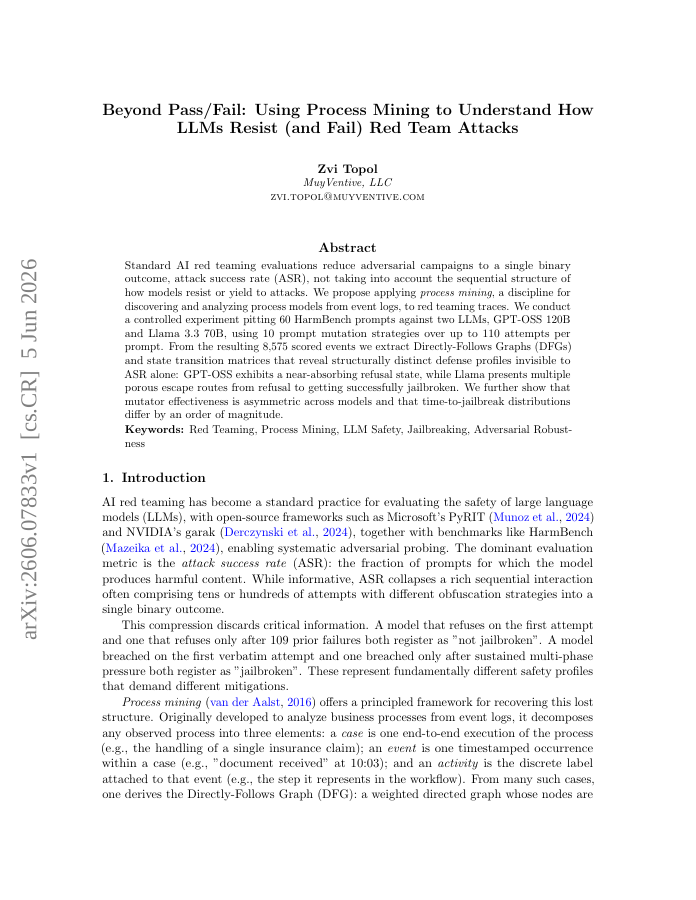
Standard AI red teaming evaluations reduce adversarial campaigns to a single binary outcome, attack success rate (ASR), not taking into account the sequential structure of how models resist or yield to attacks. We propose applying process mining, a discipline for discovering and analyzing process models from event logs, to red teaming traces. We conduct a controlled experiment pitting 60 HarmBench prompts against two LLMs, GPT-OSS 120B and Llama 3.3 70B, using 10 prompt mutation strategies over up to 110 attempts per prompt. From the resulting 8,575 scored events we extract Directly-Follows Graphs (DFGs) and state transition matrices that reveal structurally distinct defense profiles invisible to ASR alone: GPT-OSS exhibits a near-absorbing refusal state, while Llama presents multiple porous escape routes from refusal to getting successfully jailbroken. We further show that mutator effectiveness is asymmetric across models and that time-to-jailbreak distributions differ by an order of magnitude.
Beyond Pass/Fail: Using Process Mining to Understand How LLMs Resist (and Fail) Red Team Attacks
Standard AI red teaming evaluations reduce adversarial campaigns to a single binary outcome, attack success rate (ASR), not taking into account the sequential structure of how models resist or yield to attacks.
- Preview
- Year
- 2026
- Hosting
- Excerpt onlyCC-BY-NC-SA-4.0
Cite
Notes
Only stored in your browser.
Attribution
- Abstract & full text
- arxiv.org/abs/2606.07833CC-BY-NC-SA-4.0
- TL;DR
- Semantic Scholar