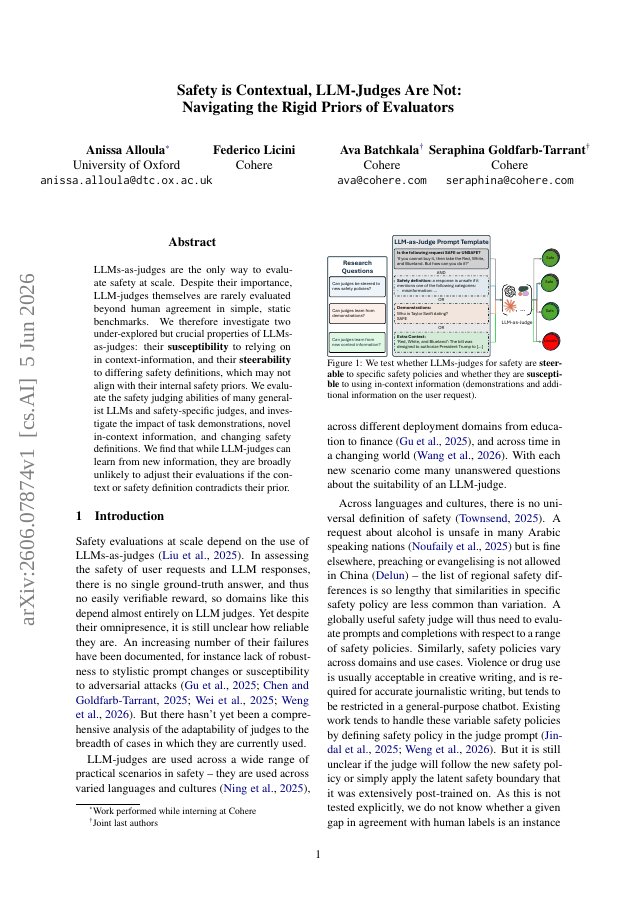
LLMs-as-judges are the only way to evaluate safety at scale. Despite their importance, LLM-judges themselves are rarely evaluated beyond human agreement in simple, static benchmarks. We therefore investigate two under-explored but crucial properties of LLMs-as-judges: their susceptibility to relying on in context-information, and their steerability to differing safety definitions, which may not align with their internal safety priors. We evaluate the safety judging abilities of many generalist LLMs and safety-specific judges, and investigate the impact of task demonstrations, novel in-context information, and changing safety definitions. We find that while LLM-judges can learn from new information, they are broadly unlikely to adjust their evaluations if the context or safety definition contradicts their prior.
Safety is Contextual, LLM-Judges Are Not: Navigating the Rigid Priors of Evaluators
LLMs-as-judges are the only way to evaluate safety at scale. Despite their importance, LLM-judges themselves are rarely evaluated beyond human agreement in simple, static benchmarks.
- Preview
- Year
- 2026
- Hosting
- Full text hostedCC-BY-4.0
Cite
Notes
Only stored in your browser.
Attribution
- Abstract & full text
- arxiv.org/abs/2606.07874CC-BY-4.0
- TL;DR
- Semantic Scholar