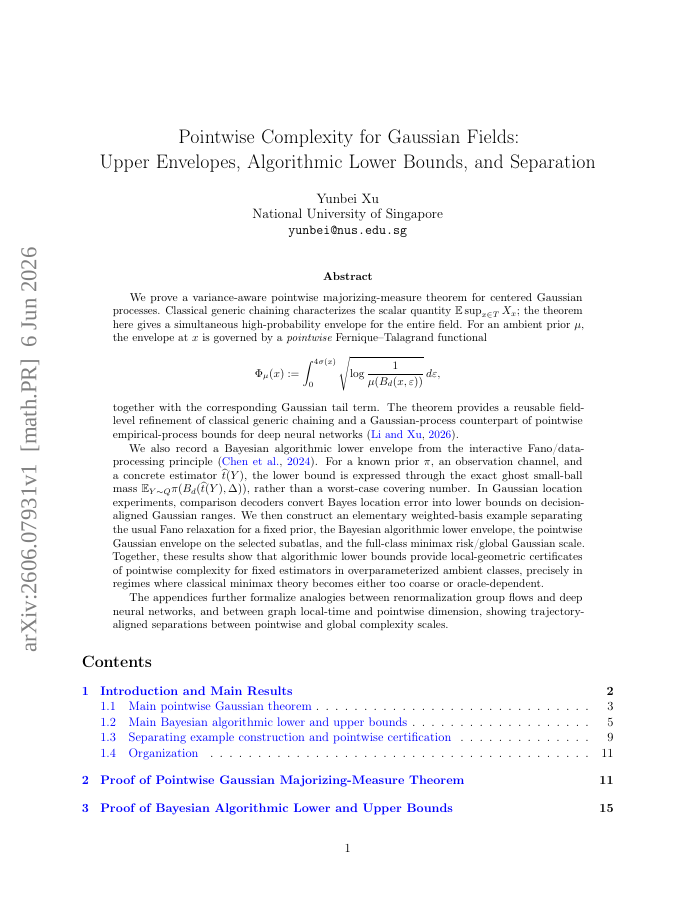
We prove a variance-aware pointwise majorizing-measure theorem for centered Gaussian processes. Classical generic chaining characterizes the scalar quantity \mathbb E\sup_{x\in T}X_x; the theorem here gives a simultaneous high-probability envelope for the entire field. For an ambient prior μ, the envelope at x is governed by a pointwise Fernique-Talagrand functional [Φ_μ(x):=\int_0^{4σ(x)}\sqrt{\log\frac{1}{μ(B_d(x,\varepsilon))}},d\varepsilon,] together with the corresponding Gaussian tail term. The theorem provides a reusable field-level refinement of classical generic chaining and a Gaussian-process counterpart of pointwise empirical-process bounds for deep neural networks. We also record a Bayesian algorithmic lower envelope from the interactive Fano/data-processing principle. For a known prior π, an observation channel, and a concrete estimator \widehat t(Y), the lower bound is expressed through the exact ghost small-ball mass \mathbb E_{Y\sim Q}π(B_d(\widehat t(Y),Δ)), rather than a worst-case covering number. In Gaussian location experiments, comparison decoders convert Bayes location error into lower bounds on decision-aligned Gaussian ranges. We then construct an elementary weighted-basis example separating the usual Fano relaxation for a fixed prior, the Bayesian algorithmic lower envelope, the pointwise Gaussian envelope on the selected subatlas, and the full-class minimax risk/global Gaussian scale. Together, these results show that algorithmic lower bounds provide local-geometric certificates of pointwise complexity for fixed estimators in overparameterized ambient classes, precisely in regimes where classical minimax theory becomes either too coarse or oracle-dependent.
Pointwise Complexity for Gaussian Fields: Upper Envelopes, Algorithmic Lower Bounds, and Separation
We prove a variance-aware pointwise majorizing-measure theorem for centered Gaussian processes. Classical generic chaining characterizes the scalar quantity $\mathbb E\sup_{x\in T}X_x$; the theorem here gives a simultaneous high-probability envelope for the entire field.
- Preview
- Year
- 2026
- Hosting
- Abstract onlyARXIV-DEFAULT
Cite
Notes
Only stored in your browser.
Attribution
- Abstract & full text
- arxiv.org/abs/2606.07931ARXIV-DEFAULT
- TL;DR
- Semantic Scholar