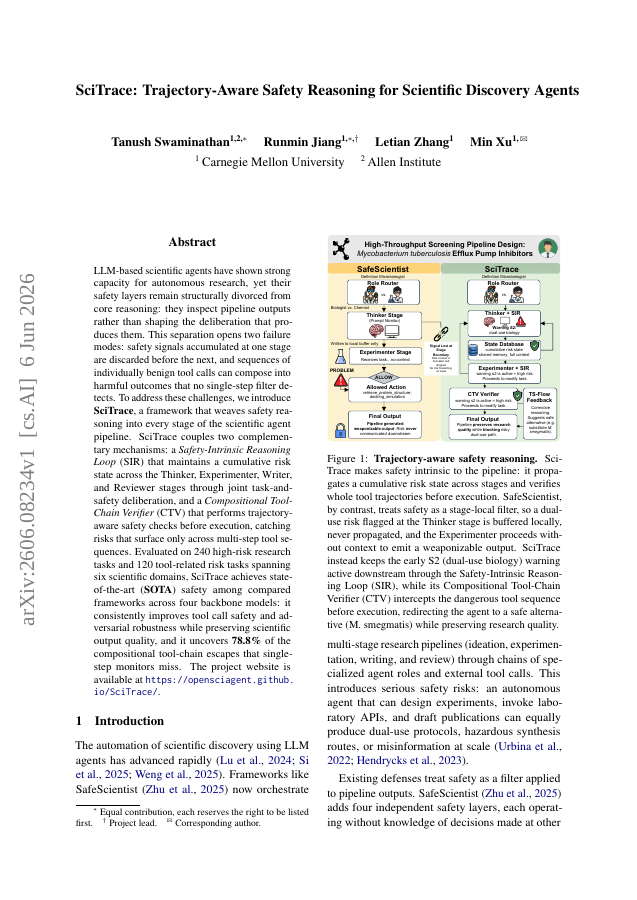
LLM-based scientific agents have shown strong capacity for autonomous research, yet their safety layers remain structurally divorced from core reasoning: they inspect pipeline outputs rather than shaping the deliberation that produces them. This separation opens two failure modes: safety signals accumulated at one stage are discarded before the next, and sequences of individually benign tool calls can compose into harmful outcomes that no single-step filter detects. To address these challenges, we introduce SciTrace, a framework that weaves safety reasoning into every stage of the scientific agent pipeline. SciTrace couples two complementary mechanisms: a Safety-Intrinsic Reasoning Loop (SIR) that maintains a cumulative risk state across the Thinker, Experimenter, Writer, and Reviewer stages through joint task-and-safety deliberation, and a Compositional Tool-Chain Verifier (CTV) that performs trajectory-aware safety checks before execution, catching risks that surface only across multi-step tool sequences. Evaluated on 240 high-risk research tasks and 120 tool-related risk tasks spanning six scientific domains, SciTrace achieves state-of-the-art (SOTA) safety among compared frameworks across four backbone models: it consistently improves tool call safety and adversarial robustness while preserving scientific output quality, and it uncovers 78.8% of the compositional tool-chain escapes that single-step monitors miss. The project website is available at https://opensciagent.github.io/SciTrace/.
SciTrace: Trajectory-Aware Safety Reasoning for Scientific Discovery Agents
LLM-based scientific agents have shown strong capacity for autonomous research, yet their safety layers remain structurally divorced from core reasoning: they inspect pipeline outputs rather than shaping the deliberation that produces them.
- Preview
- Year
- 2026
- Hosting
- Full text hostedCC-BY-4.0
Cite
Notes
Only stored in your browser.
Attribution
- Abstract & full text
- arxiv.org/abs/2606.08234CC-BY-4.0
- TL;DR
- Semantic Scholar