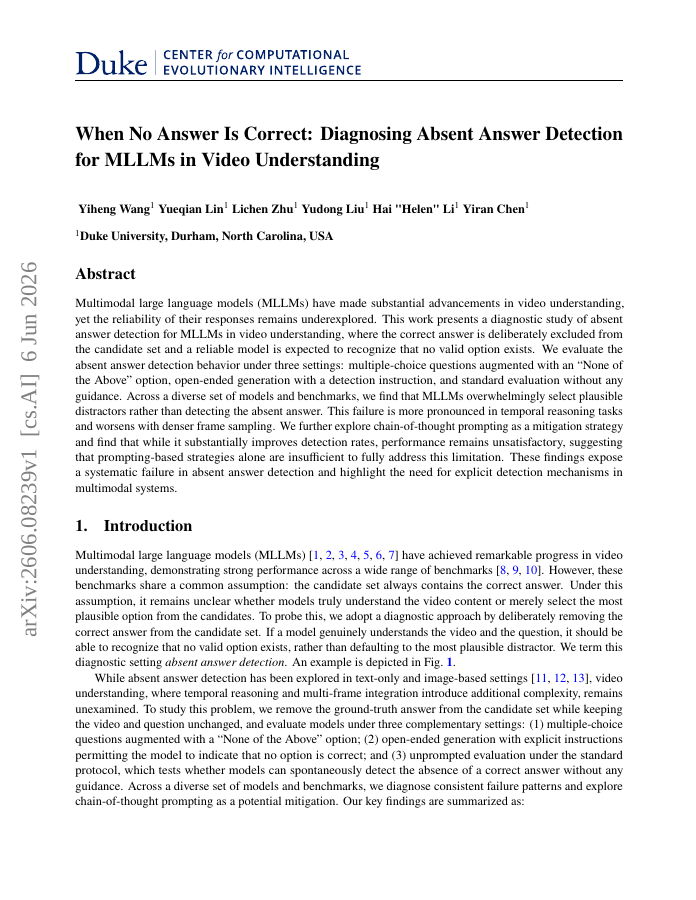
Multimodal large language models (MLLMs) have made substantial advancements in video understanding, yet the reliability of their responses remains underexplored. This work presents a diagnostic study of absent answer detection for MLLMs in video understanding, where the correct answer is deliberately excluded from the candidate set and a reliable model is expected to recognize that no valid option exists. We evaluate the absent answer detection behavior under three settings: multiple-choice questions augmented with an ``None of the Above'' option, open-ended generation with a detection instruction, and standard evaluation without any guidance. Across a diverse set of models and benchmarks, we find that MLLMs overwhelmingly select plausible distractors rather than detecting the absent answer. This failure is more pronounced in temporal reasoning tasks and worsens with denser frame sampling. We further explore chain-of-thought prompting as a mitigation strategy and find that while it substantially improves detection rates, performance remains unsatisfactory, suggesting that prompting-based strategies alone are insufficient to fully address this limitation. These findings expose a systematic failure in absent answer detection and highlight the need for explicit detection mechanisms in multimodal systems.
When No Answer Is Correct: Diagnosing Absent Answer Detection for MLLMs in Video Understanding
Multimodal large language models (MLLMs) have made substantial advancements in video understanding, yet the reliability of their responses remains underexplored. This work presents a diagnostic study of absent answer detection for MLLMs in video understanding, where the correct…
- Preview
- Year
- 2026
- Hosting
- Abstract onlyARXIV-DEFAULT
Cite
Notes
Only stored in your browser.
Attribution
- Abstract & full text
- arxiv.org/abs/2606.08239ARXIV-DEFAULT
- TL;DR
- Semantic Scholar