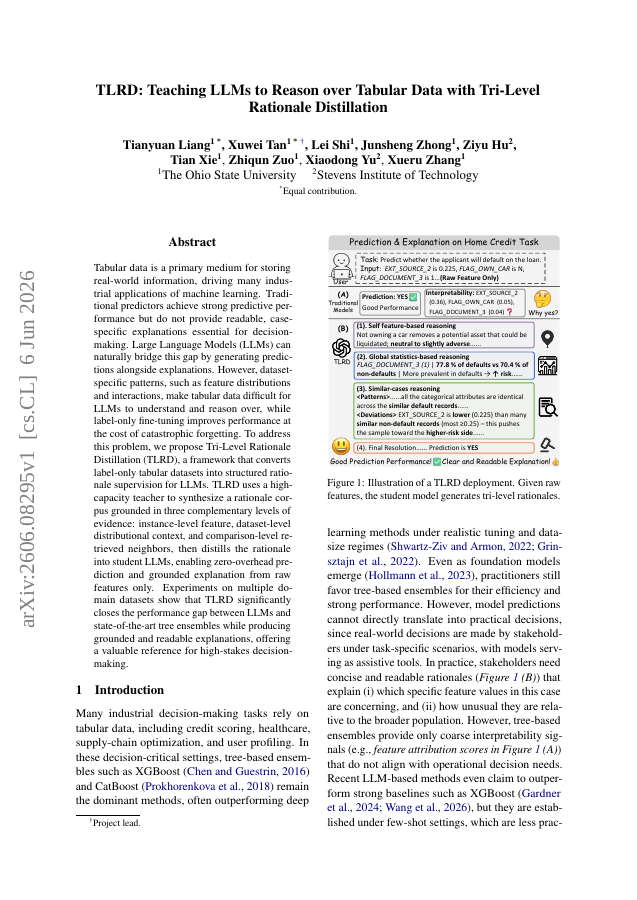
Tabular data is a primary medium for storing real-world information, driving many industrial applications of machine learning. Traditional predictors achieve strong predictive performance but do not provide readable, case-specific explanations essential for decision-making. Large Language Models (LLMs) can naturally bridge this gap by generating predictions alongside explanations. However, dataset-specific patterns, such as feature distributions and interactions, make tabular data difficult for LLMs to understand and reason over, while label-only fine-tuning improves performance at the cost of catastrophic forgetting. To address this problem, we propose Tri-Level Rationale Distillation (TLRD), a framework that converts label-only tabular datasets into structured rationale supervision for LLMs. TLRD uses a high-capacity teacher to synthesize a rationale corpus grounded in three complementary levels of evidence: instance-level feature, dataset-level distributional context, and comparison-level retrieved neighbors, then distills the rationale into student LLMs, enabling zero-overhead prediction and grounded explanation from raw features only. Experiments on multiple domain datasets show that TLRD significantly closes the performance gap between LLMs and state-of-the-art tree ensembles while producing grounded and readable explanations, offering a valuable reference for high-stakes decision-making.
TLRD: Teaching LLMs to Reason over Tabular Data with Tri-Level Rationale Distillation
Tabular data is a primary medium for storing real-world information, driving many industrial applications of machine learning. Traditional predictors achieve strong predictive performance but do not provide readable, case-specific explanations essential for decision-making.
- Preview
- Year
- 2026
- Hosting
- Full text hostedCC-BY-4.0
Cite
Notes
Only stored in your browser.
Attribution
- Abstract & full text
- arxiv.org/abs/2606.08295CC-BY-4.0
- TL;DR
- Semantic Scholar