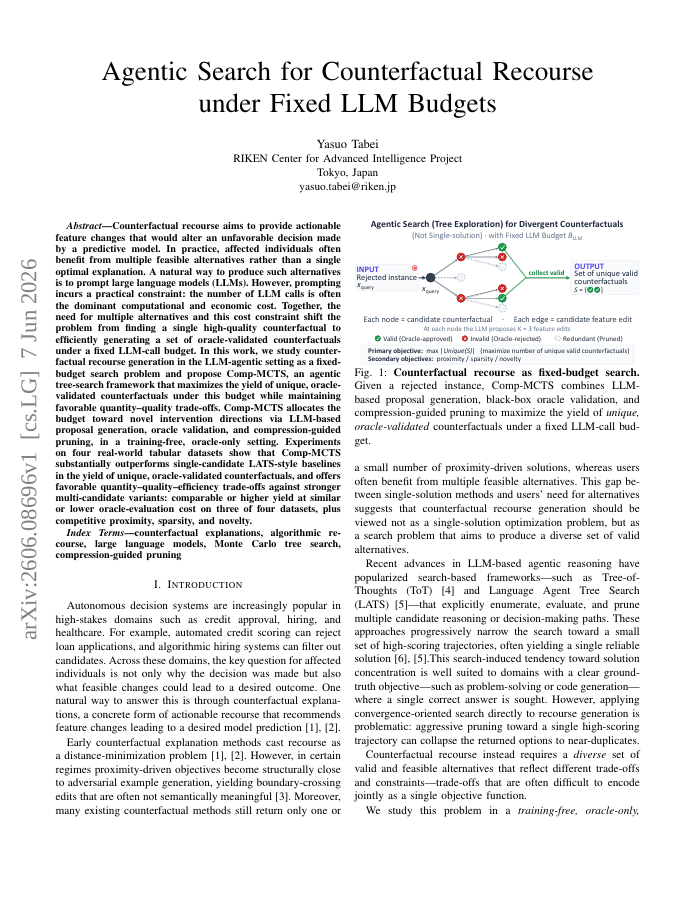
Counterfactual recourse aims to provide actionable feature changes that would alter an unfavorable decision made by a predictive model. In practice, affected individuals often benefit from multiple feasible alternatives rather than a single optimal explanation. A natural way to produce such alternatives is to prompt large language models (LLMs). However, prompting incurs a practical constraint: the number of LLM calls is often the dominant computational and economic cost. Together, the need for multiple alternatives and this cost constraint shift the problem from finding a single high-quality counterfactual to efficiently generating a set of oracle-validated counterfactuals under a fixed LLM-call budget. In this work, we study counterfactual recourse generation in the LLM-agentic setting as a fixed-budget search problem and propose Comp-MCTS, an agentic tree-search framework that maximizes the yield of unique, oracle-validated counterfactuals under this budget while maintaining favorable quantity--quality trade-offs. Comp-MCTS allocates the budget toward novel intervention directions via LLM-based proposal generation, oracle validation, and compression-guided pruning, in a training-free, oracle-only setting. Experiments on four real-world tabular datasets show that Comp-MCTS substantially outperforms single-candidate LATS-style baselines in the yield of unique, oracle-validated counterfactuals, and offers favorable quantity--quality--efficiency trade-offs against stronger multi-candidate variants: comparable or higher yield at similar or lower oracle-evaluation cost on three of four datasets, plus competitive proximity, sparsity, and novelty.
Agentic Search for Counterfactual Recourse under Fixed LLM Budgets
Counterfactual recourse aims to provide actionable feature changes that would alter an unfavorable decision made by a predictive model. In practice, affected individuals often benefit from multiple feasible alternatives rather than a single optimal explanation.
- Preview
- Year
- 2026
- Hosting
- Abstract onlyARXIV-DEFAULT
Cite
Notes
Only stored in your browser.
Attribution
- Abstract & full text
- arxiv.org/abs/2606.08696ARXIV-DEFAULT
- TL;DR
- Semantic Scholar