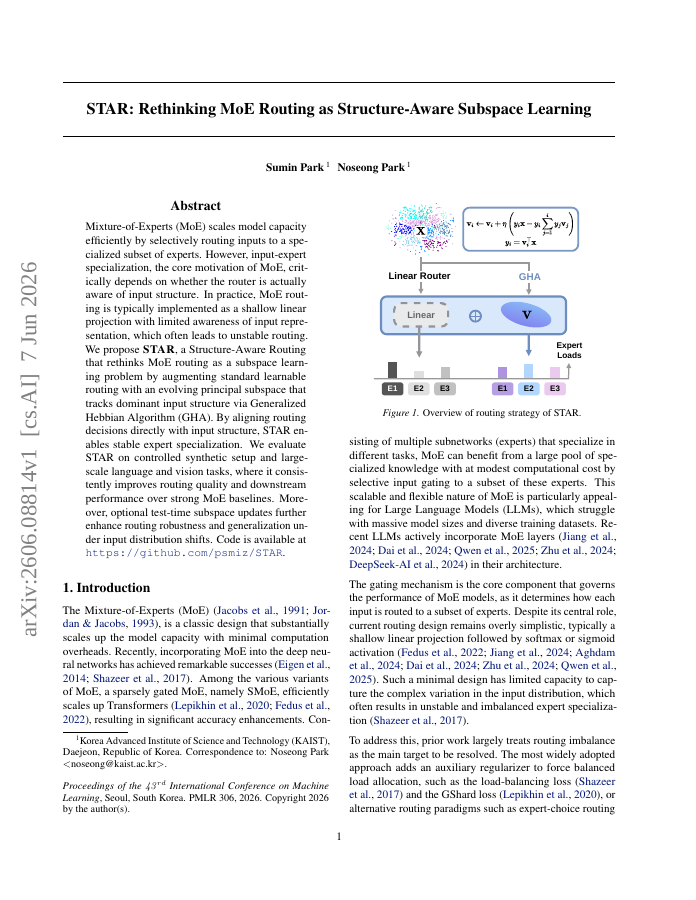
Mixture-of-Experts (MoE) scales model capacity efficiently by selectively routing inputs to a specialized subset of experts. However, input-expert specialization, the core motivation of MoE, critically depends on whether the router is actually aware of input structure. In practice, MoE routing is typically implemented as a shallow linear projection with limited awareness of input representation, which often leads to unstable routing. We propose STAR, a Structure Aware Routing that rethinks MoE routing as a subspace learning problem by augmenting standard learnable routing with an evolving principal subspace that tracks dominant input structure via Generalized Hebbian Algorithm (GHA). By aligning routing decisions directly with input structure, STAR enables stable expert specialization. We evaluate STAR on controlled synthetic setup and large-scale language and vision tasks, where it consistently improves routing quality and downstream performance over strong MoE baselines. Moreover, optional test-time subspace updates further enhance routing robustness and generalization under input distribution shifts.
STAR: Rethinking MoE Routing as Structure-Aware Subspace Learning
Mixture-of-Experts (MoE) scales model capacity efficiently by selectively routing inputs to a specialized subset of experts. However, input-expert specialization, the core motivation of MoE, critically depends on whether the router is actually aware of input structure.
- Preview
- Year
- 2026
- Hosting
- Abstract onlyARXIV-DEFAULT
Cite
Notes
Only stored in your browser.
Attribution
- Abstract & full text
- arxiv.org/abs/2606.08814ARXIV-DEFAULT
- TL;DR
- Semantic Scholar