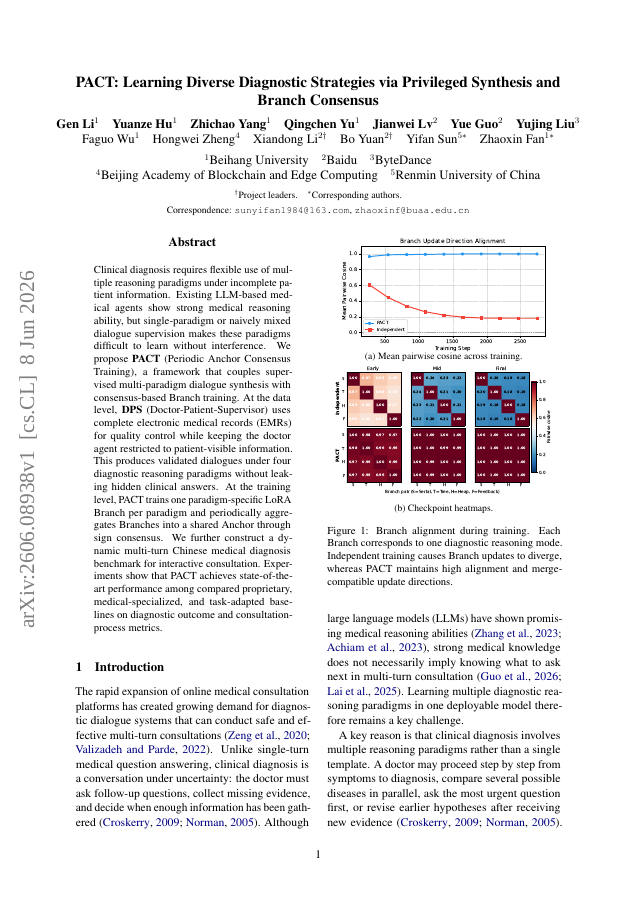
Clinical diagnosis requires flexible use of multiple reasoning paradigms under incomplete patient information. Existing LLM-based medical agents show strong medical reasoning ability, but single-paradigm or naively mixed dialogue supervision makes these paradigms difficult to learn without interference. We propose PACT (Periodic Anchor Consensus Training), a framework that couples supervised multi-paradigm dialogue synthesis with consensus-based Branch training. At the data level, DPS (Doctor-Patient-Supervisor) uses complete electronic medical records (EMRs) for quality control while keeping the doctor agent restricted to patient-visible information. This produces validated dialogues under four diagnostic reasoning paradigms without leaking hidden clinical answers. At the training level, PACT trains one paradigm-specific LoRA Branch per paradigm and periodically aggregates Branches into a shared Anchor through sign consensus. We further construct a dynamic multi-turn Chinese medical diagnosis benchmark for interactive consultation. Experiments show that PACT achieves state-of-the-art performance among compared proprietary, medical-specialized, and task-adapted baselines on diagnostic outcome and consultation-process metrics.
PACT: Learning Diverse Diagnostic Strategies via Privileged Synthesis and Branch Consensus
Clinical diagnosis requires flexible use of multiple reasoning paradigms under incomplete patient information. Existing LLM-based medical agents show strong medical reasoning ability, but single-paradigm or naively mixed dialogue supervision makes these paradigms difficult to…
- Preview
- Year
- 2026
- Hosting
- Full text hostedCC-BY-4.0
Cite
Notes
Only stored in your browser.
Attribution
- Abstract & full text
- arxiv.org/abs/2606.08938CC-BY-4.0
- TL;DR
- Semantic Scholar