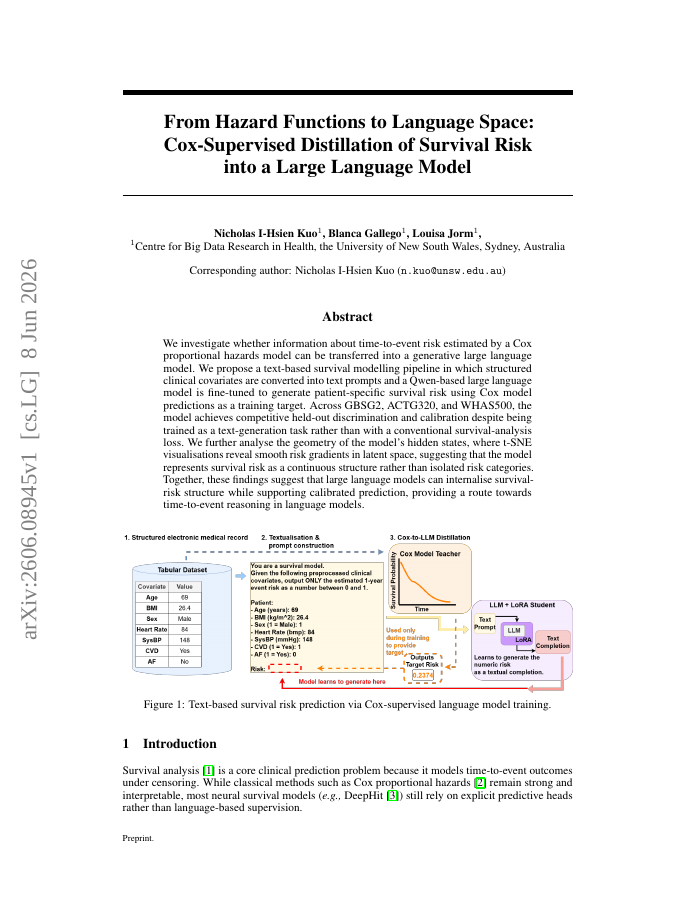
We investigate whether information about time-to-event risk estimated by a Cox proportional hazards model can be transferred into a generative large language model. We propose a text-based survival modelling pipeline in which structured clinical covariates are converted into text prompts and a Qwen-based large language model is fine-tuned to generate patient-specific survival risk using Cox model predictions as a training target. Across GBSG2, ACTG320, and WHAS500, the model achieves competitive held-out discrimination and calibration despite being trained as a text-generation task rather than with a conventional survival-analysis loss. We further analyse the geometry of the model's hidden states, where t-SNE visualisations reveal smooth risk gradients in latent space, suggesting that the model represents survival risk as a continuous structure rather than isolated risk categories. Together, these findings suggest that large language models can internalise survival-risk structure while supporting calibrated prediction, providing a route towards time-to-event reasoning in language models.
From Hazard Functions to Language Space: Cox-Supervised Distillation of Survival Risk into a Large Language Model
We investigate whether information about time-to-event risk estimated by a Cox proportional hazards model can be transferred into a generative large language model. We propose a text-based survival modelling pipeline in which structured clinical covariates are converted into…
- Preview
- Year
- 2026
- Hosting
- Full text hostedCC-BY-4.0
Cite
Notes
Only stored in your browser.
Attribution
- Abstract & full text
- arxiv.org/abs/2606.08945CC-BY-4.0
- TL;DR
- Semantic Scholar