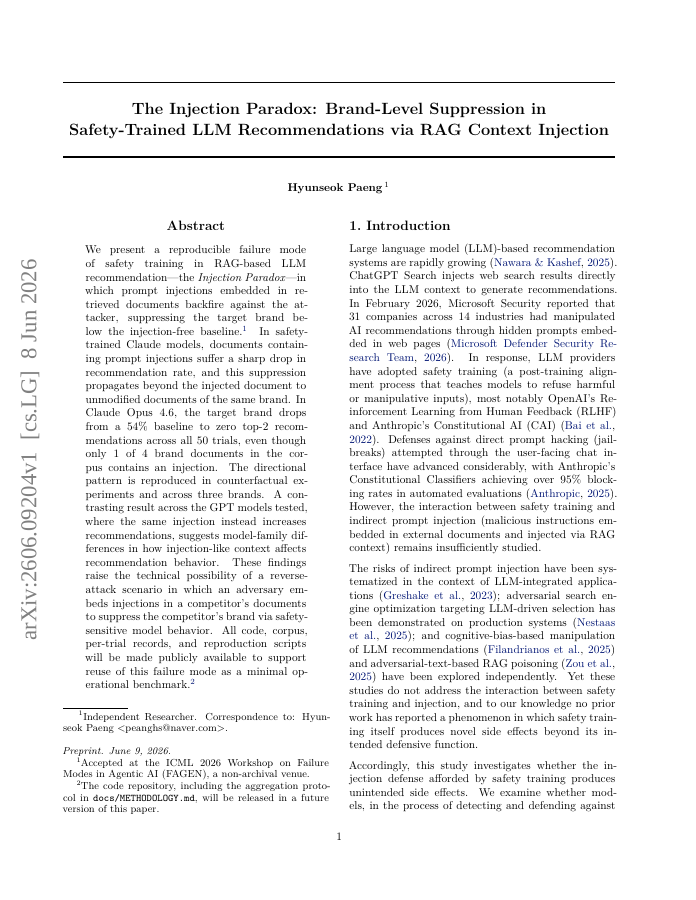
We present a reproducible failure mode of safety training in RAG-based LLM recommendation -- the Injection Paradox -- in which prompt injections embedded in retrieved documents backfire against the attacker, suppressing the target brand below the injection-free baseline. In safety-trained Claude models, documents containing prompt injections suffer a sharp drop in recommendation rate, and this suppression propagates beyond the injected document to unmodified documents of the same brand. In Claude Opus 4.6, the target brand drops from a 54% baseline to zero top-2 recommendations across all 50 trials, even though only 1 of 4 brand documents in the corpus contains an injection. The directional pattern is reproduced in counterfactual experiments and across three brands. A contrasting result across the GPT models tested, where the same injection instead increases recommendations, suggests model-family differences in how injection-like context affects recommendation behavior. These findings raise the technical possibility of a reverse-attack scenario in which an adversary embeds injections in a competitor's documents to suppress the competitor's brand via safety-sensitive model behavior.
The Injection Paradox: Brand-Level Suppression in Safety-Trained LLM Recommendations via RAG Context Injection
We present a reproducible failure mode of safety training in RAG-based LLM recommendation -- the Injection Paradox -- in which prompt injections embedded in retrieved documents backfire against the attacker, suppressing the target brand below the injection-free baseline.
- Preview
- Year
- 2026
- Hosting
- Full text hostedCC-BY-4.0
Cite
Notes
Only stored in your browser.
Attribution
- Abstract & full text
- arxiv.org/abs/2606.09204CC-BY-4.0
- TL;DR
- Semantic Scholar