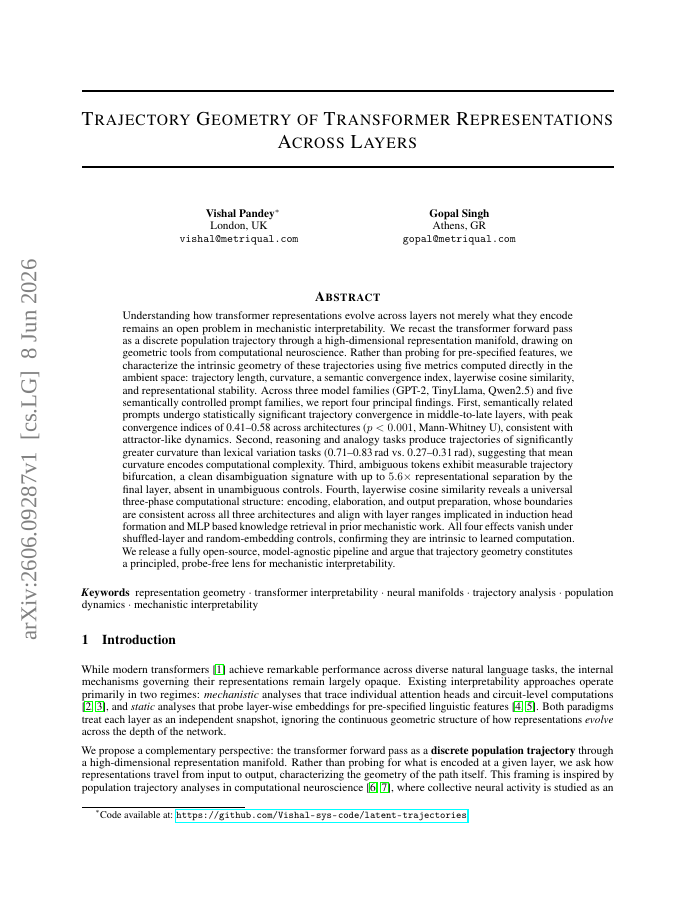
Understanding how transformer representations evolve across layers, not merely what they encode, remains an open problem in mechanistic interpretability. We recast the transformer forward pass as a discrete population trajectory through a high-dimensional representation manifold, drawing on geometric tools from computational neuroscience. Rather than probing for pre-specified features, we characterize trajectory geometry using five metrics computed directly in the ambient space: trajectory length, curvature, a semantic convergence index, layerwise cosine similarity, and representational stability. Across three model families (GPT-2, TinyLlama, Qwen2.5) and five controlled prompt families, we report four findings. First, semantically related prompts converge significantly in middle-to-late layers (peak CI 0.41--0.58, p<0.001, Mann-Whitney U), consistent with attractor-like dynamics. Second, reasoning tasks produce trajectories of greater curvature than lexical variations (0.71--0.83 rad vs. 0.27--0.31 rad), suggesting curvature encodes computational complexity. Third, ambiguous tokens exhibit trajectory bifurcation with up to 5.6x representational separation by the final layer, absent in unambiguous controls. Fourth, layerwise cosine similarity reveals a universal three-phase structure: encoding, elaboration, and output preparation, consistent across all three architectures. All four effects vanish under shuffled-layer and random-embedding controls. We release a fully open-source, model-agnostic pipeline and argue that trajectory geometry constitutes a principled, probe-free lens for mechanistic interpretability.
Trajectory Geometry of Transformer Representations Across Layers
Understanding how transformer representations evolve across layers, not merely what they encode, remains an open problem in mechanistic interpretability. We recast the transformer forward pass as a discrete population trajectory through a high-dimensional representation…
- Preview
- Year
- 2026
- Hosting
- Full text hostedCC-BY-4.0
Cite
Notes
Only stored in your browser.
Attribution
- Abstract & full text
- arxiv.org/abs/2606.09287CC-BY-4.0
- TL;DR
- Semantic Scholar