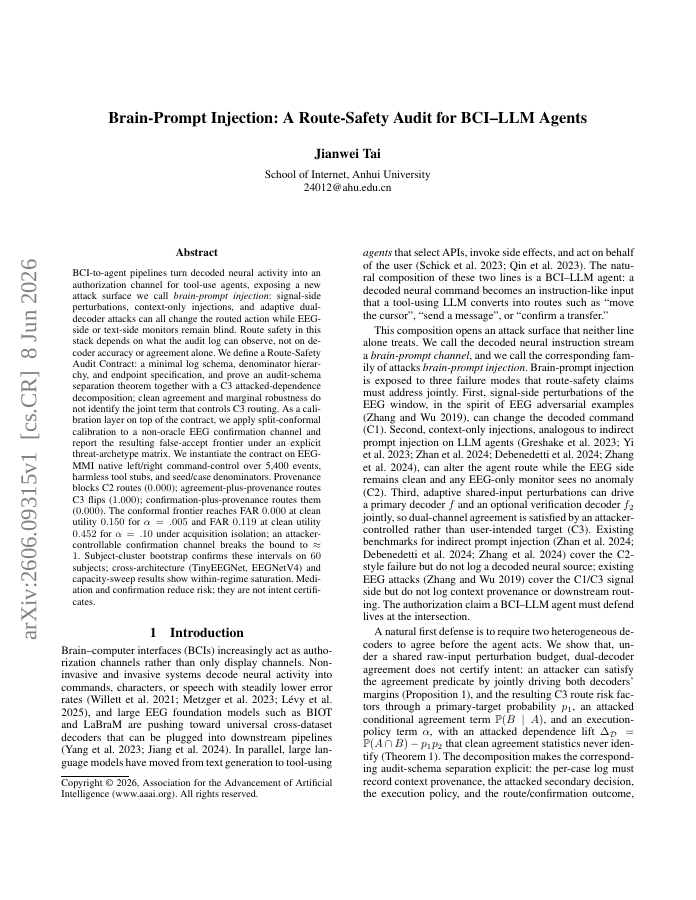
BCI-to-agent pipelines turn decoded neural activity into an authorization channel for tool-use agents, exposing a new attack surface we call brain-prompt injection: signal-side perturbations, context-only injections, and adaptive dual-decoder attacks can all change the routed action while EEG-side or text-side monitors remain blind. Route safety in this stack depends on what the audit log can observe, not on decoder accuracy or agreement alone. We define a Route-Safety Audit Contract: a minimal log schema, denominator hierarchy, and endpoint specification, and prove an audit-schema separation theorem together with a C3 attacked-dependence decomposition; clean agreement and marginal robustness do not identify the joint term that controls C3 routing. As a calibration layer on top of the contract, we apply split-conformal calibration to a non-oracle EEG confirmation channel and report the resulting false-accept frontier under an explicit threat-archetype matrix. We instantiate the contract on EEGMMI native left/right command-control over 5{,}400 events, harmless tool stubs, and seed/case denominators. Provenance blocks C2 routes (0.000); agreement-plus-provenance routes C3 flips (1.000); confirmation-plus-provenance routes them (0.000). The conformal frontier reaches FAR 0.000 at clean utility 0.150 for α=.005 and FAR 0.119 at clean utility 0.452 for α=.10 under acquisition isolation; an attacker-controllable confirmation channel breaks the bound to \approx!1. Subject-cluster bootstrap confirms these intervals on 60 subjects; cross-architecture (TinyEEGNet, EEGNetV4) and capacity-sweep results show within-regime saturation. Mediation and confirmation reduce risk; they are not intent certificates.
Brain-Prompt Injection: A Route-Safety Audit for BCI-LLM Agents
BCI-to-agent pipelines turn decoded neural activity into an authorization channel for tool-use agents, exposing a new attack surface we call \emph{brain-prompt injection}: signal-side perturbations, context-only injections, and adaptive dual-decoder attacks can all change the…
- Preview
- Year
- 2026
- Hosting
- Full text hostedCC-BY-4.0
Cite
Notes
Only stored in your browser.
Attribution
- Abstract & full text
- arxiv.org/abs/2606.09315CC-BY-4.0
- TL;DR
- Semantic Scholar