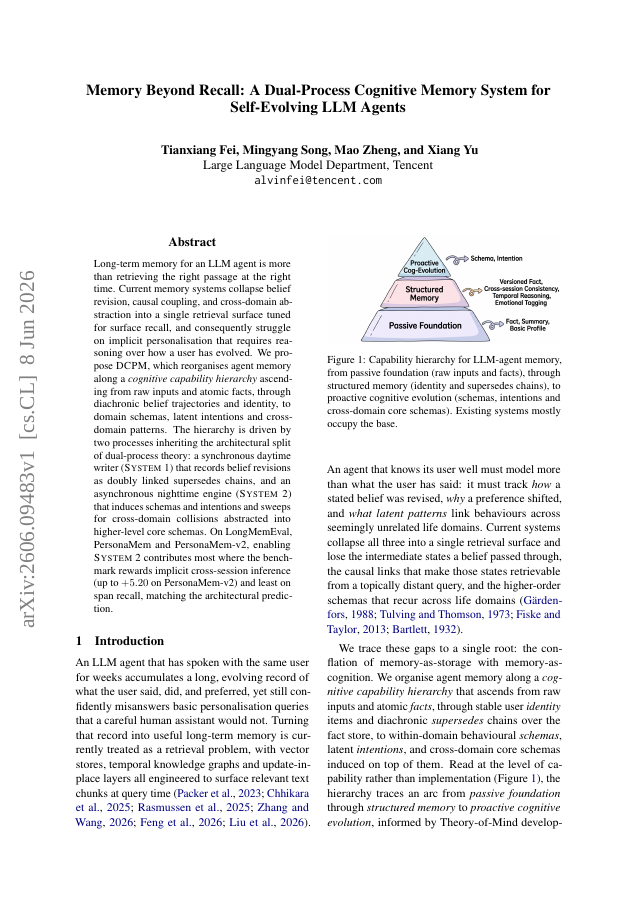
Long-term memory for an LLM agent is more than retrieving the right passage at the right time. Current memory systems collapse belief revision, causal coupling, and cross-domain abstraction into a single retrieval surface tuned for surface recall, and consequently struggle on implicit personalisation that requires reasoning over how a user has evolved. We propose DCPM, which reorganises agent memory along a cognitive capability hierarchy ascending from raw inputs and atomic facts, through diachronic belief trajectories and identity, to domain schemas, latent intentions and cross-domain patterns. The hierarchy is driven by two processes inheriting the architectural split of dual-process theory: a synchronous daytime writer (System1) that records belief revisions as doubly linked supersedes chains, and an asynchronous nighttime engine (System2) that induces schemas and intentions and sweeps for cross-domain collisions abstracted into higher-level core schemas. On LongMemEval, PersonaMem and PersonaMem-v2, enabling System2 contributes most where the benchmark rewards implicit cross-session inference (up to +5.20 on PersonaMem-v2) and least on span recall, matching the architectural prediction.
Memory Beyond Recall: A Dual-Process Cognitive Memory System for Self-Evolving LLM Agents
Long-term memory for an LLM agent is more than retrieving the right passage at the right time. Current memory systems collapse belief revision, causal coupling, and cross-domain abstraction into a single retrieval surface tuned for surface recall, and consequently struggle on…
- Preview
- Year
- 2026
- Hosting
- Abstract onlyARXIV-DEFAULT
Cite
Notes
Only stored in your browser.
Attribution
- Abstract & full text
- arxiv.org/abs/2606.09483ARXIV-DEFAULT
- TL;DR
- Semantic Scholar