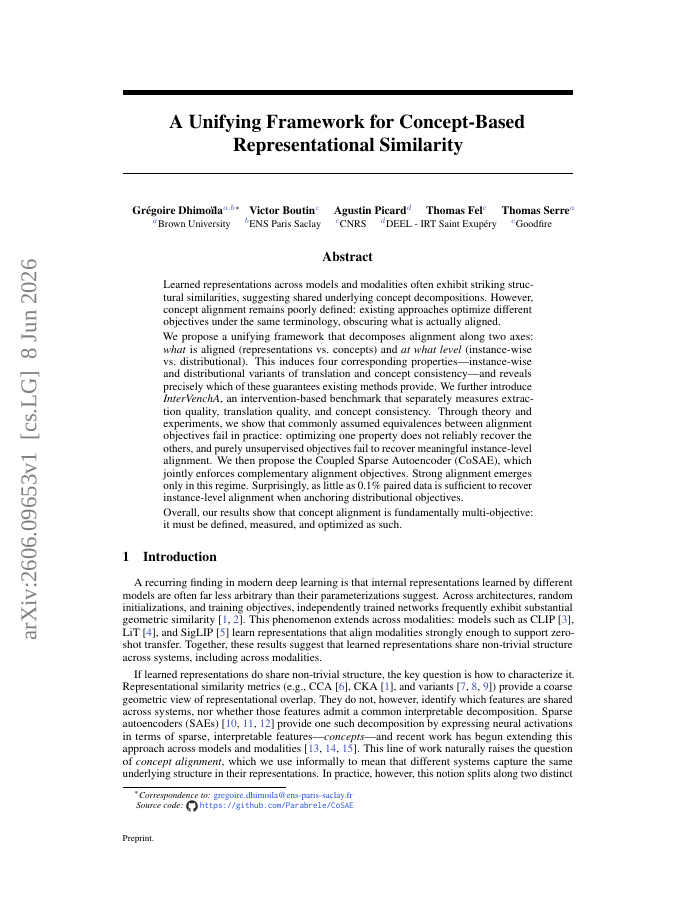
Learned representations across models and modalities often exhibit striking structural similarities, suggesting shared underlying concept decompositions. However, concept alignment remains poorly defined: existing approaches optimize different objectives under the same terminology, obscuring what is actually aligned. We propose a unifying framework that decomposes alignment along two axes: what is aligned (representations vs. concepts) and at what level (instance-wise vs. distributional). This induces four corresponding properties -- instance-wise and distributional variants of translation and concept consistency -- and reveals precisely which of these guarantees existing methods provide. We further introduce \InterVenchA, an intervention-based benchmark that separately measures extraction quality, translation quality, and concept consistency. Through theory and experiments, we show that commonly assumed equivalences between alignment objectives fail in practice: optimizing one property does not reliably recover the others, and purely unsupervised objectives fail to recover meaningful instance-level alignment. We then propose the Coupled Sparse Autoencoder (CoSAE), which jointly enforces complementary alignment objectives. Strong alignment emerges only in this regime. Surprisingly, as little as 0.1% paired data is sufficient to recover instance-level alignment when anchoring distributional objectives. Overall, our results show that concept alignment is fundamentally multi-objective: it must be defined, measured, and optimized as such.
A Unifying Framework for Concept-Based Representational Similarity
Learned representations across models and modalities often exhibit striking structural similarities, suggesting shared underlying concept decompositions. However, concept alignment remains poorly defined: existing approaches optimize different objectives under the same…
- Preview
- Year
- 2026
- Hosting
- Full text hostedCC-BY-4.0
Cite
Notes
Only stored in your browser.
Attribution
- Abstract & full text
- arxiv.org/abs/2606.09653CC-BY-4.0
- TL;DR
- Semantic Scholar