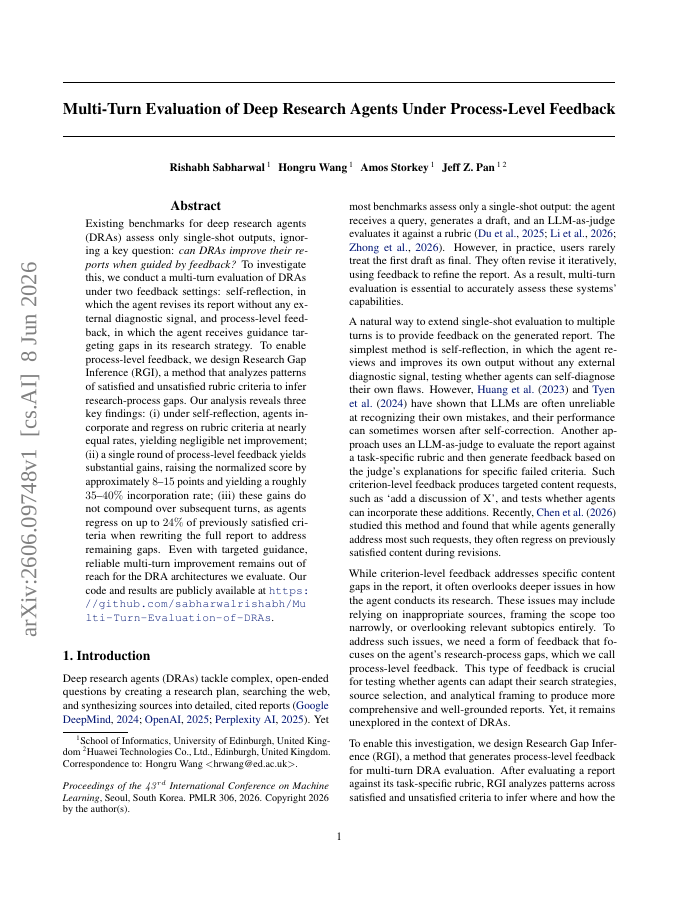
Existing benchmarks for deep research agents (DRAs) assess only single-shot outputs, ignoring a key question: can DRAs improve their reports when guided by feedback? To investigate this, we conduct a multi-turn evaluation of DRAs under two feedback settings: self-reflection, in which the agent revises its report without any external diagnostic signal, and process-level feedback, in which the agent receives guidance targeting gaps in its research strategy. To enable process-level feedback, we design Research Gap Inference (RGI), a method that analyzes patterns of satisfied and unsatisfied rubric criteria to infer research-process gaps. Our analysis reveals three key findings: (i) under self-reflection, agents incorporate and regress on rubric criteria at nearly equal rates, yielding negligible net improvement; (ii) a single round of process-level feedback yields substantial gains, raising the normalized score by approximately 8-15 points and yielding a roughly 35-40% incorporation rate; (iii) these gains do not compound over subsequent turns, as agents regress on up to 24% of previously satisfied criteria when rewriting the full report to address remaining gaps. Even with targeted guidance, reliable multi-turn improvement remains out of reach for the DRA architectures we evaluate. Our code and results are publicly available at https://github.com/sabharwalrishabh/Multi-Turn-Evaluation-of-DRAs.
Multi-Turn Evaluation of Deep Research Agents Under Process-Level Feedback
Existing benchmarks for deep research agents (DRAs) assess only single-shot outputs, ignoring a key question: can DRAs improve their reports when guided by feedback? To investigate this, we conduct a multi-turn evaluation of DRAs under two feedback settings: self-reflection, in…
- Preview
- Year
- 2026
- Hosting
- Full text hostedCC-BY-4.0
Cite
Notes
Only stored in your browser.
Attribution
- Abstract & full text
- arxiv.org/abs/2606.09748CC-BY-4.0
- TL;DR
- Semantic Scholar