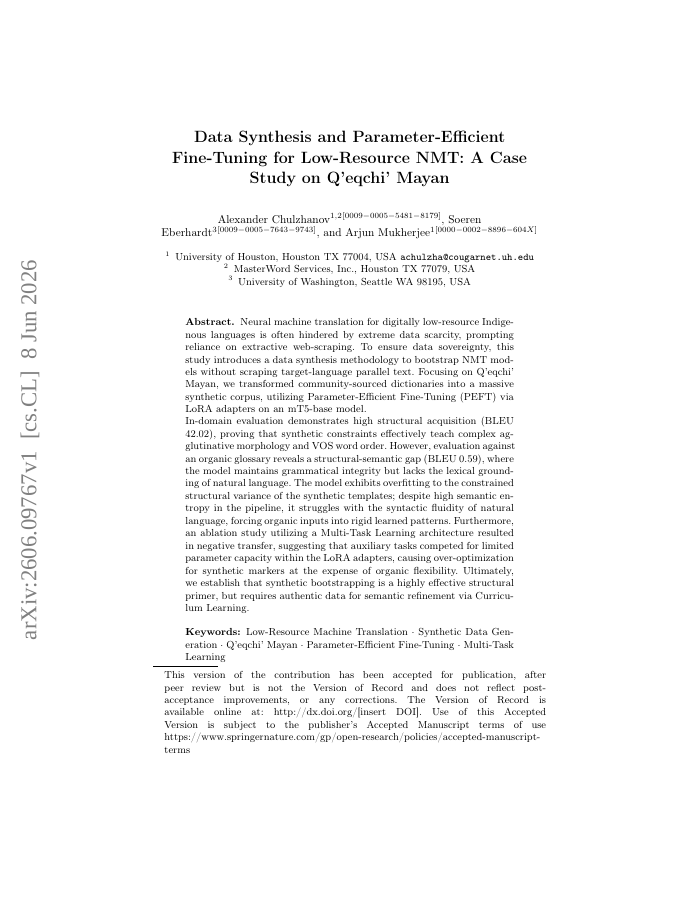
Neural machine translation for digitally low-resource Indigenous languages is often hindered by extreme data scarcity, prompting reliance on extractive web-scraping. To ensure data sovereignty, this study introduces a data synthesis methodology to bootstrap NMT models without scraping target-language parallel text. Focusing on Q'eqchi' Mayan, we transformed community-sourced dictionaries into a massive synthetic corpus, utilizing Parameter-Efficient Fine-Tuning (PEFT) via LoRA adapters on an mT5-base model. In-domain evaluation demonstrates high structural acquisition (BLEU 42.02), proving that synthetic constraints effectively teach complex agglutinative morphology and VOS word order. However, evaluation against an organic glossary reveals a structural-semantic gap (BLEU 0.59), where the model maintains grammatical integrity but lacks the lexical grounding of natural language. The model exhibits overfitting to the constrained structural variance of the synthetic templates; despite high semantic entropy in the pipeline, it struggles with the syntactic fluidity of natural language, forcing organic inputs into rigid learned patterns. Furthermore, an ablation study utilizing a Multi-Task Learning architecture resulted in negative transfer, suggesting that auxiliary tasks competed for limited parameter capacity within the LoRA adapters, causing over-optimization for synthetic markers at the expense of organic flexibility. Ultimately, we establish that synthetic bootstrapping is a highly effective structural primer, but requires authentic data for semantic refinement via Curriculum Learning.
Data Synthesis and Parameter-Efficient Fine-Tuning for Low-Resource NMT: A Case Study on Q'eqchi' Mayan
Neural machine translation for digitally low-resource Indigenous languages is often hindered by extreme data scarcity, prompting reliance on extractive web-scraping. To ensure data sovereignty, this study introduces a data synthesis methodology to bootstrap NMT models without…
- Preview
- Year
- 2026
- Hosting
- Abstract onlyARXIV-DEFAULT
Cite
Notes
Only stored in your browser.
Attribution
- Abstract & full text
- arxiv.org/abs/2606.09767ARXIV-DEFAULT
- TL;DR
- Semantic Scholar