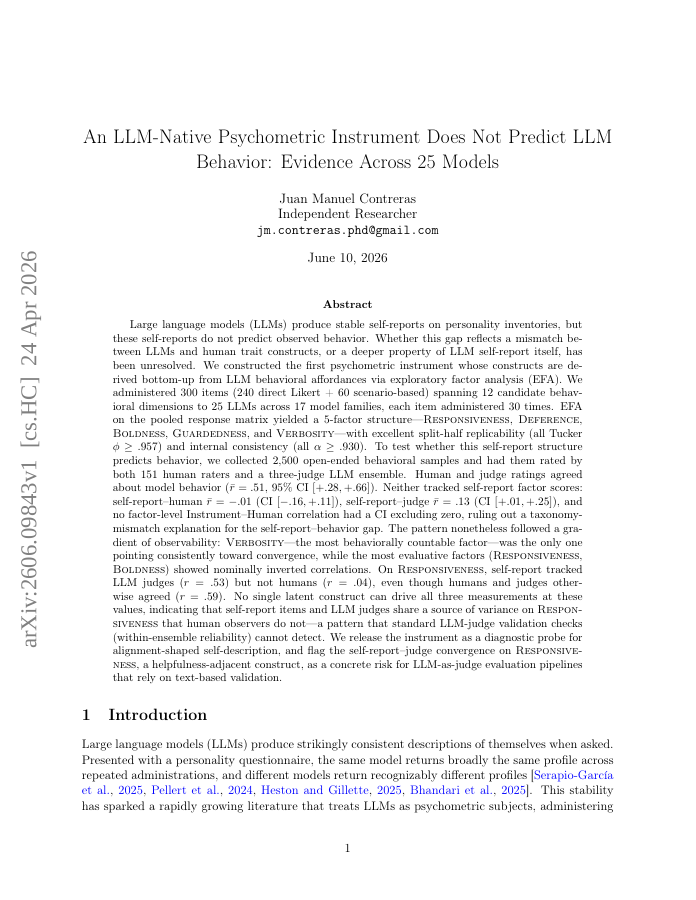
Large language models (LLMs) produce stable self-reports on personality inventories, but these self-reports do not predict observed behavior. Whether this gap reflects a mismatch between LLMs and human trait constructs, or a deeper property of LLM self-report itself, has been unresolved. We constructed the first psychometric instrument whose constructs are derived bottom-up from LLM behavioral affordances via exploratory factor analysis (EFA). We administered 300 items (240 direct Likert + 60 scenario-based) spanning 12 candidate behavioral dimensions to 25 LLMs across 17 model families, each item administered 30 times. EFA yielded a 5-factor structure -- Responsiveness, Deference, Boldness, Guardedness, and Verbosity -- with excellent split-half replicability (all Tucker ϕ\geq .957) and internal consistency (all α\geq .930). To test predictive validity, we collected 2,500 open-ended behavioral samples rated by 151 human raters and a three-judge LLM ensemble. Human and judge ratings agreed (\bar{r} = .51), but neither tracked self-report: self-report--human \bar{r} = -.01, self-report--judge \bar{r} = .13, with no factor-level self-report--human CI excluding zero. On Responsiveness, self-report correlated with LLM judges (r = .53) but not humans (r = .04), even though humans and judges agreed (r = .59) -- indicating self-report items and LLM judges share variance that human observers do not, a confound invisible to within-ensemble reliability checks. We release the instrument as a diagnostic probe for alignment-shaped self-description and a concrete risk factor for LLM-as-judge pipelines.
An LLM-Native Psychometric Instrument Does Not Predict LLM Behavior: Evidence Across 25 Models
Large language models (LLMs) produce stable self-reports on personality inventories, but these self-reports do not predict observed behavior. Whether this gap reflects a mismatch between LLMs and human trait constructs, or a deeper property of LLM self-report itself, has been…
- Preview
- Year
- 2026
- Hosting
- Full text hostedCC-BY-4.0
Cite
Notes
Only stored in your browser.
Attribution
- Abstract & full text
- arxiv.org/abs/2606.09843CC-BY-4.0
- TL;DR
- Semantic Scholar