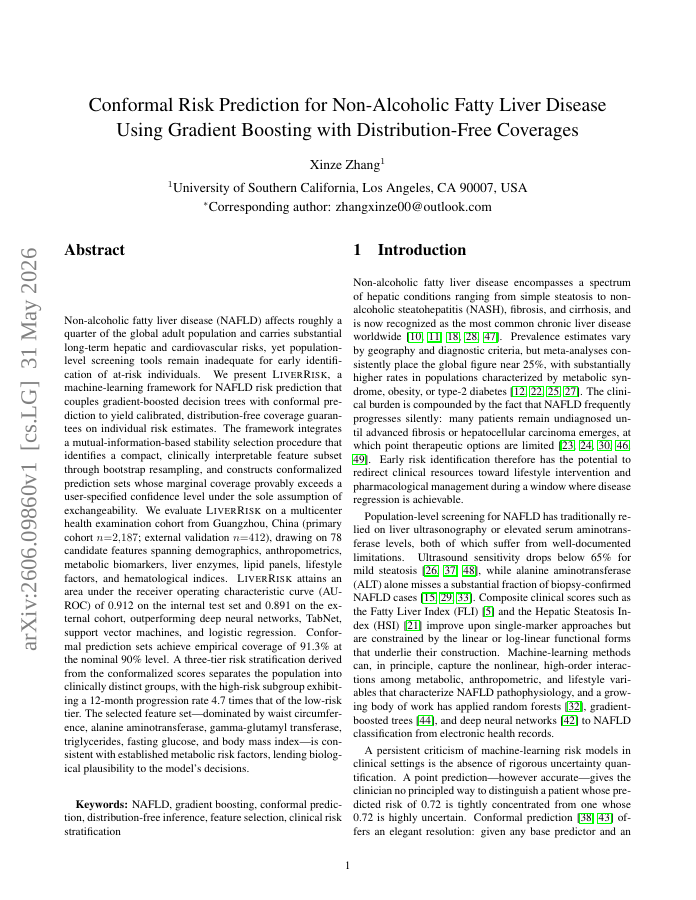
Non-alcoholic fatty liver disease (NAFLD) affects roughly 25% of global adults, posing substantial hepatic and cardiovascular risks. Yet, population-level screening tools remain inadequate. We present Method, a machine-learning framework for NAFLD risk prediction coupling gradient-boosted decision trees with conformal prediction to yield calibrated, distribution-free coverage guarantees on individual risk estimates. It integrates a mutual-information-based stability selection procedure to identify a compact, clinically interpretable feature subset via bootstrap resampling, constructing prediction sets whose marginal coverage provably exceeds a user-specified confidence level. We evaluated Method on a multicenter cohort from Guangzhou, China (primary n=2,187; external validation n=412) using 78 candidate features across demographics, metabolic biomarkers, and lifestyle factors. Method achieves an AUROC of 0.912 internally and 0.891 externally, outperforming deep neural networks, TabNet, support vector machines, and logistic regression. Conformal prediction sets achieve 91.3% empirical coverage at the 90% nominal level. A three-tier risk stratification derived from these scores separates the population into distinct groups, with the high-risk subgroup showing a 12-month progression rate 4.7 times that of the low-risk tier. The selected features -- notably waist circumference, ALT, GGT, triglycerides, fasting glucose, and BMI -- align with established metabolic risk factors, providing biological plausibility.
Conformal Risk Prediction for Non-Alcoholic Fatty Liver Disease Using Gradient Boosting with Distribution-Free Coverages
Non-alcoholic fatty liver disease (NAFLD) affects roughly 25% of global adults, posing substantial hepatic and cardiovascular risks. Yet, population-level screening tools remain inadequate.
- Preview
- Year
- 2026
- Hosting
- Abstract onlyARXIV-DEFAULT
Cite
Notes
Only stored in your browser.
Attribution
- Abstract & full text
- arxiv.org/abs/2606.09860ARXIV-DEFAULT
- TL;DR
- Semantic Scholar