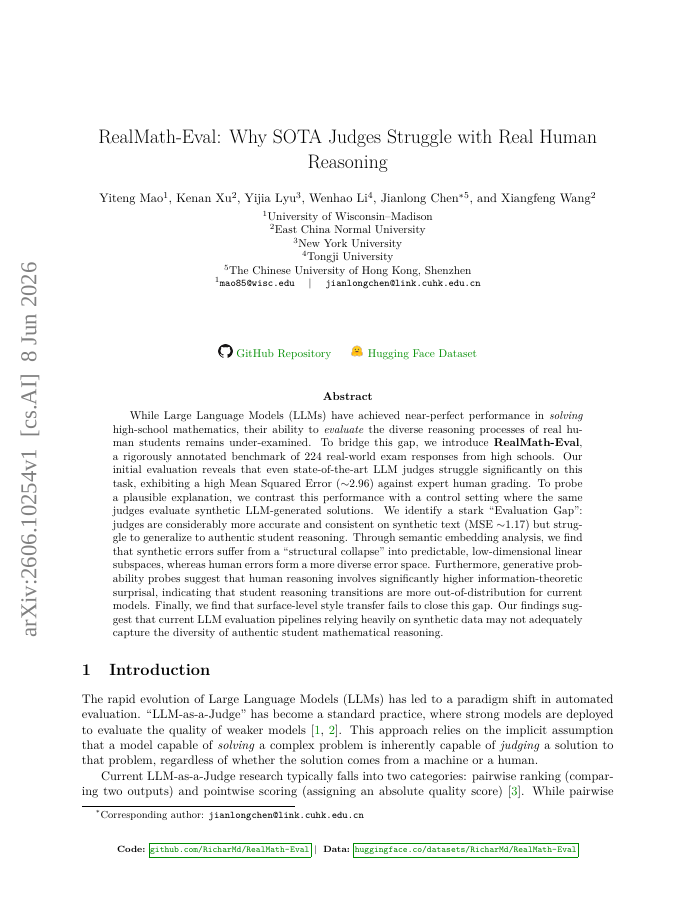
While Large Language Models (LLMs) have achieved near-perfect performance in solving high-school mathematics, their ability to evaluate the diverse reasoning processes of real human students remains under-examined. To bridge this gap, we introduce RealMath-Eval, a rigorously annotated benchmark of 224 real-world exam responses from high schools. Our initial evaluation reveals that even state-of-the-art LLM judges struggle significantly on this task, exhibiting a high Mean Squared Error (\sim2.96) against expert human grading. To probe a plausible explanation, we contrast this performance with a control setting where the same judges evaluate synthetic LLM-generated solutions. We identify a stark Evaluation Gap'': judges are considerably more accurate and consistent on synthetic text (MSE \sim1.17) but struggle to generalize to authentic student reasoning. Through semantic embedding analysis, we find that synthetic errors suffer from a structural collapse'' into predictable, low-dimensional linear subspaces, whereas human errors form a more diverse error space. Furthermore, generative probability probes suggest that human reasoning involves significantly higher information-theoretic surprisal, indicating that student reasoning transitions are more out-of-distribution for current models. Finally, we find that surface-level style transfer fails to close this gap. Our findings suggest that current LLM evaluation pipelines relying heavily on synthetic data may not adequately capture the diversity of authentic student mathematical reasoning.
RealMath-Eval: Why SOTA Judges Struggle with Real Human Reasoning
While Large Language Models (LLMs) have achieved near-perfect performance in \emph{solving} high-school mathematics, their ability to \emph{evaluate} the diverse reasoning processes of real human students remains under-examined.
- Preview
- Year
- 2026
- Hosting
- Abstract onlyARXIV-DEFAULT
Cite
Notes
Only stored in your browser.
Attribution
- Abstract & full text
- arxiv.org/abs/2606.10254ARXIV-DEFAULT
- TL;DR
- Semantic Scholar