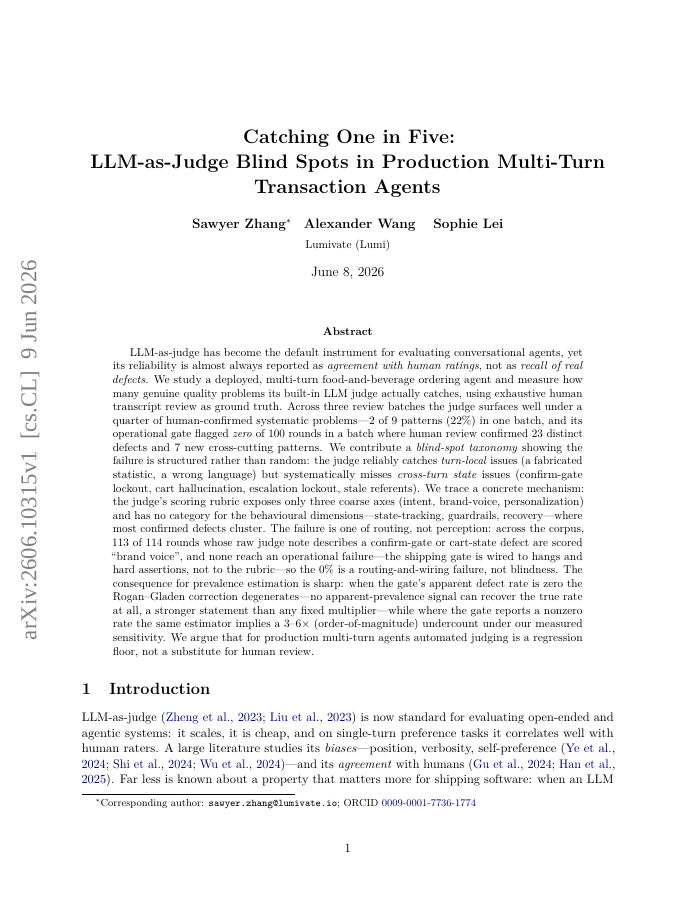
LLM-as-judge is the default instrument for evaluating conversational agents, yet its reliability is almost always reported as agreement with human ratings, not recall of real defects. We study a deployed multi-turn food-and-beverage ordering agent and measure how many genuine quality problems its built-in LLM judge catches, using exhaustive human transcript review as ground truth. Across three batches the judge surfaces well under a quarter of human-confirmed systematic problems -- 2 of 9 patterns (22%) in one batch, and its operational gate flagged zero of 100 rounds in a batch where humans confirmed 23 distinct defects and 7 new cross-cutting patterns. Our blind-spot taxonomy shows the failure is structured, not random: the judge catches turn-local issues (a fabricated statistic, a wrong language) but misses cross-turn state issues (confirm-gate lockout, cart hallucination, escalation lockout, stale referents). The mechanism: the scoring rubric exposes only three coarse axes (intent, brand-voice, personalization) and has no category for the behavioural dimensions -- state-tracking, guardrails, recovery -- where most defects cluster. The failure is routing, not perception: 113 of 114 rounds whose raw judge note describes a confirm-gate or cart-state defect are scored "brand voice", and none reach an operational failure -- the gate is wired to hangs and hard assertions, not the rubric -- so the 0% is a routing-and-wiring failure, not blindness. The consequence for prevalence estimation is sharp: when the apparent defect rate is zero the Rogan-Gladen correction degenerates -- no signal can recover the true rate -- while where the gate reports a nonzero rate the same estimator implies a 3-6x undercount under our measured sensitivity. For production multi-turn agents, automated judging is a regression floor, not a substitute for human review.
Catching One in Five: LLM-as-Judge Blind Spots in Production Multi-Turn Transaction Agents
LLM-as-judge is the default instrument for evaluating conversational agents, yet its reliability is almost always reported as agreement with human ratings, not recall of real defects.
- Preview
- Year
- 2026
- Hosting
- Full text hostedCC-BY-4.0
Cite
Notes
Only stored in your browser.
Attribution
- Abstract & full text
- arxiv.org/abs/2606.10315CC-BY-4.0
- TL;DR
- Semantic Scholar