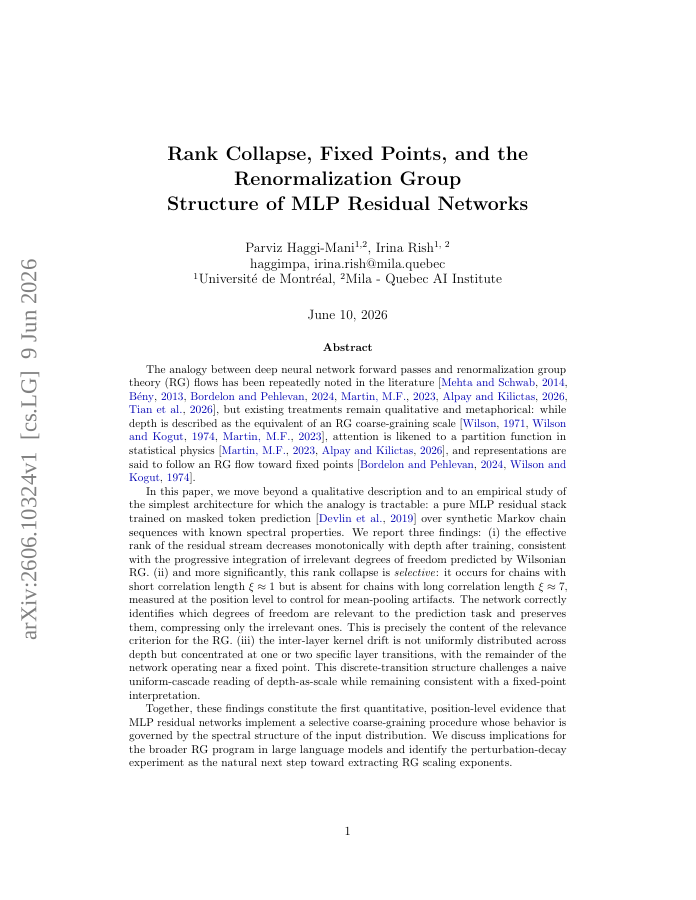
The analogy between deep neural network forward passes and renormalization group (RG) flows has been repeatedly noted in the literature, but existing treatments remain qualitative: depth is described as a coarse-graining scale, attention is likened to a partition function, and representations are said to flow toward fixed points. No existing work has defined a measurable RG order parameter, tested it under controlled variation of the input distribution, or made quantitative predictions that are empirically verified. We study the simplest architecture for which the analogy is tractable: a pure MLP residual stack trained on masked token prediction over synthetic Markov chain sequences with known spectral properties. We report three findings. (i) The effective rank of the residual stream decreases monotonically with depth after training, consistent with progressive integration of irrelevant degrees of freedom. (ii) This rank collapse is selective: it occurs for chains with short correlation length approximately 1 but is absent for chains with long correlation length approximately 7, measured at the position level to control for mean-pooling artifacts. The network preserves exactly the degrees of freedom relevant to the prediction task, the content of the RG relevance criterion. (iii) Inter-layer kernel drift is concentrated at one or two specific transitions, with the remainder of the network near a fixed point, consistent with a discrete fixed-point plateau. Together these findings constitute the first quantitative, position-level evidence that MLP residual networks implement a selective coarse-graining procedure governed by the spectral structure of the input distribution.
Rank Collapse, Fixed Points, and the Renormalization Group Structure of MLP Residual Networks
The analogy between deep neural network forward passes and renormalization group (RG) flows has been repeatedly noted in the literature, but existing treatments remain qualitative: depth is described as a coarse-graining scale, attention is likened to a partition function, and…
- Preview
- Year
- 2026
- Hosting
- Abstract onlyARXIV-DEFAULT
Cite
Notes
Only stored in your browser.
Attribution
- Abstract & full text
- arxiv.org/abs/2606.10324ARXIV-DEFAULT
- TL;DR
- Semantic Scholar