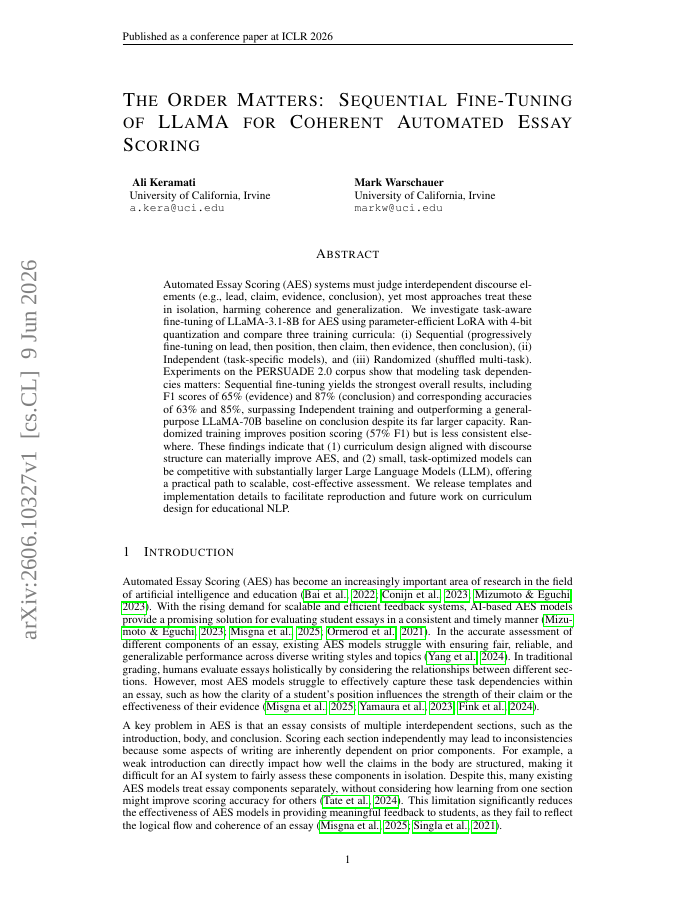
Automated Essay Scoring (AES) systems must judge interdependent discourse elements (e.g., lead, claim, evidence, conclusion), yet most approaches treat these in isolation, harming coherence and generalization. We investigate task-aware fine-tuning of LLaMA-3.1-8B for AES using parameter-efficient LoRA with 4-bit quantization and compare three training curricula: (i) Sequential (progressively fine-tuning on lead, then position, then claim, then evidence, then conclusion), (ii) Independent (task-specific models), and (iii) Randomized (shuffled multi-task). Experiments on the PERSUADE 2.0 corpus show that modeling task dependencies matters: Sequential fine-tuning yields the strongest overall results, including F1 scores of 65% (evidence) and 87% (conclusion) and corresponding accuracies of 63% and 85%, surpassing Independent training and outperforming a general-purpose LLaMA-70B baseline on conclusion despite its far larger capacity. Randomized training improves position scoring (57% F1) but is less consistent elsewhere. These findings indicate that (1) curriculum design aligned with discourse structure can materially improve AES, and (2) small, task-optimized models can be competitive with substantially larger Large Language Models (LLM), offering a practical path to scalable, cost-effective assessment. We release templates and implementation details to facilitate reproduction and future work on curriculum design for educational NLP.
The Order Matters: Sequential Fine-Tuning of LLaMA for Coherent Automated Essay Scoring
Automated Essay Scoring (AES) systems must judge interdependent discourse elements (e.g., lead, claim, evidence, conclusion), yet most approaches treat these in isolation, harming coherence and generalization.
- Preview
- Year
- 2026
- Hosting
- Full text hostedCC-BY-4.0
Cite
Notes
Only stored in your browser.
Attribution
- Abstract & full text
- arxiv.org/abs/2606.10327CC-BY-4.0
- TL;DR
- Semantic Scholar