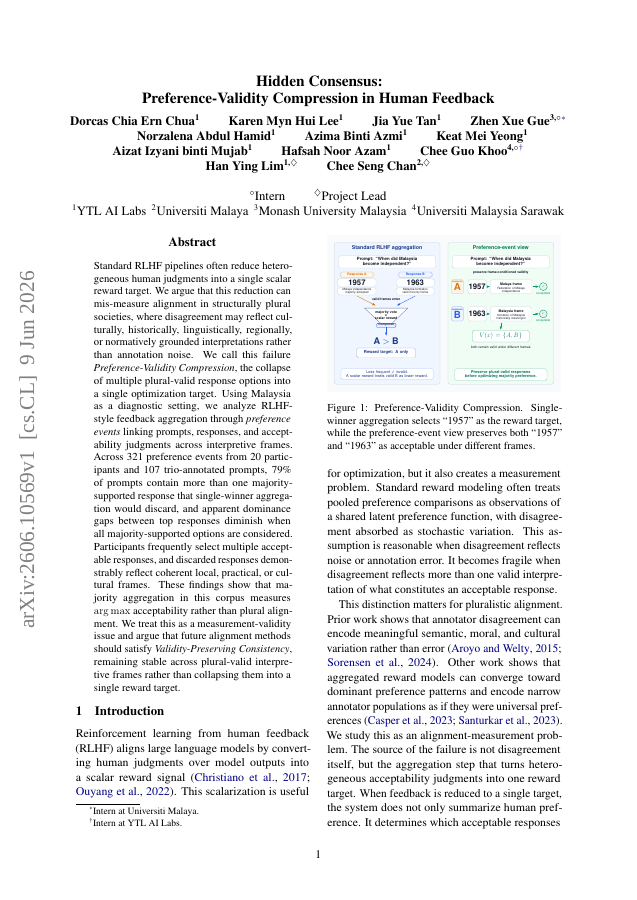
Standard RLHF pipelines often reduce heterogeneous human judgments into a single scalar reward target. We argue that this reduction can mis-measure alignment in structurally plural societies, where disagreement may reflect culturally, historically, linguistically, regionally, or normatively grounded interpretations rather than annotation noise. We call this failure Preference-Validity Compression, the collapse of multiple plural-valid response options into a single optimization target. Using Malaysia as a diagnostic setting, we analyze RLHF-style feedback aggregation through preference events linking prompts, responses, and acceptability judgments across interpretive frames. Across 321 preference events from 20 participants and 107 trio-annotated prompts, 79% of prompts contain more than one majority-supported response that single-winner aggregation would discard, and apparent dominance gaps between top responses diminish when all majority-supported options are considered. Participants frequently select multiple acceptable responses, and discarded responses demonstrably reflect coherent local, practical, or cultural frames. These findings show that majority aggregation in this corpus measures argmax acceptability rather than plural alignment. We treat this as a measurement-validity issue and argue that future alignment methods should satisfy Validity-Preserving Consistency, remaining stable across plural-valid interpretive frames rather than collapsing them into a single reward target.
Hidden Consensus:Preference-Validity Compression in Human Feedback
Standard RLHF pipelines often reduce heterogeneous human judgments into a single scalar reward target. We argue that this reduction can mis-measure alignment in structurally plural societies, where disagreement may reflect culturally, historically, linguistically, regionally, or…
- Preview
- Year
- 2026
- Hosting
- Abstract onlyARXIV-DEFAULT
Cite
Notes
Only stored in your browser.
Attribution
- Abstract & full text
- arxiv.org/abs/2606.10569ARXIV-DEFAULT
- TL;DR
- Semantic Scholar