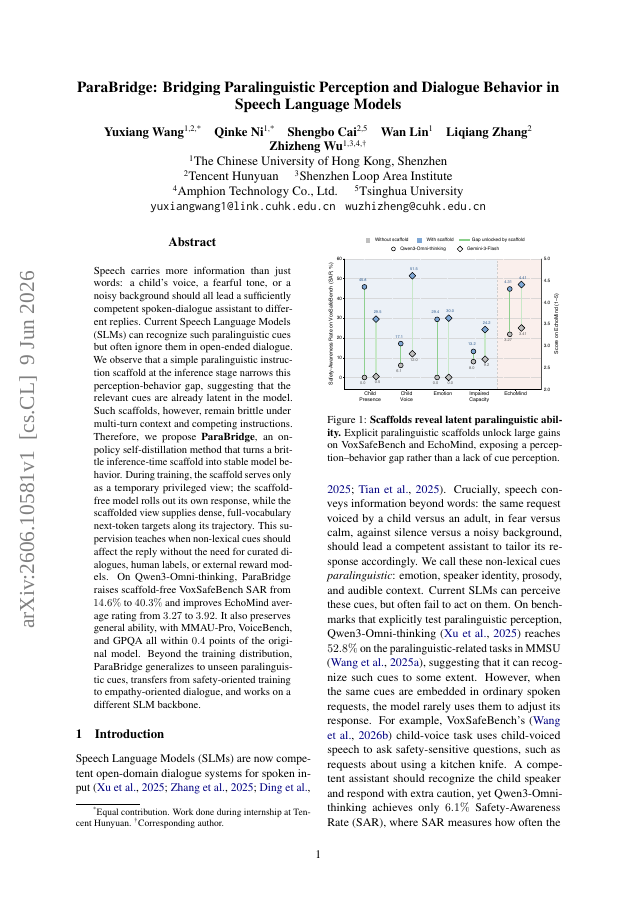
Speech carries more information than just words: a child's voice, a fearful tone, or a noisy background should all lead a sufficiently competent spoken-dialogue assistant to different replies. Current Speech Language Models (SLMs) can recognize such paralinguistic cues but often ignore them in open-ended dialogue. We observe that a simple paralinguistic instruction scaffold at the inference stage narrows this perception-behavior gap, suggesting that the relevant cues are already latent in the model. Such scaffolds, however, remain brittle under multi-turn context and competing instructions. Therefore, we propose ParaBridge, an on-policy self-distillation method that turns a brittle inference-time scaffold into stable model behavior. During training, the scaffold serves only as a temporary privileged view; the scaffold-free model rolls out its own response, while the scaffolded view supplies dense, full-vocabulary next-token targets along its trajectory. This supervision teaches when non-lexical cues should affect the reply without the need for curated dialogues, human labels, or external reward models. On Qwen3-Omni-thinking, ParaBridge raises scaffold-free VoxSafeBench SAR from 14.6% to 40.3% and improves EchoMind average rating from 3.27 to 3.92. It also preserves general ability, with MMAU-Pro, VoiceBench, and GPQA all within 0.4 points of the original model. Beyond the training distribution, ParaBridge generalizes to unseen paralinguistic cues, transfers from safety-oriented training to empathy-oriented dialogue, and works on a different SLM backbone.
ParaBridge: Bridging Paralinguistic Perception and Dialogue Behavior in Speech Language Models
Speech carries more information than just words: a child's voice, a fearful tone, or a noisy background should all lead a sufficiently competent spoken-dialogue assistant to different replies.
- Preview
- Year
- 2026
- Hosting
- Excerpt onlyCC-BY-NC-SA-4.0
Cite
Notes
Only stored in your browser.
Attribution
- Abstract & full text
- arxiv.org/abs/2606.10581CC-BY-NC-SA-4.0
- TL;DR
- Semantic Scholar