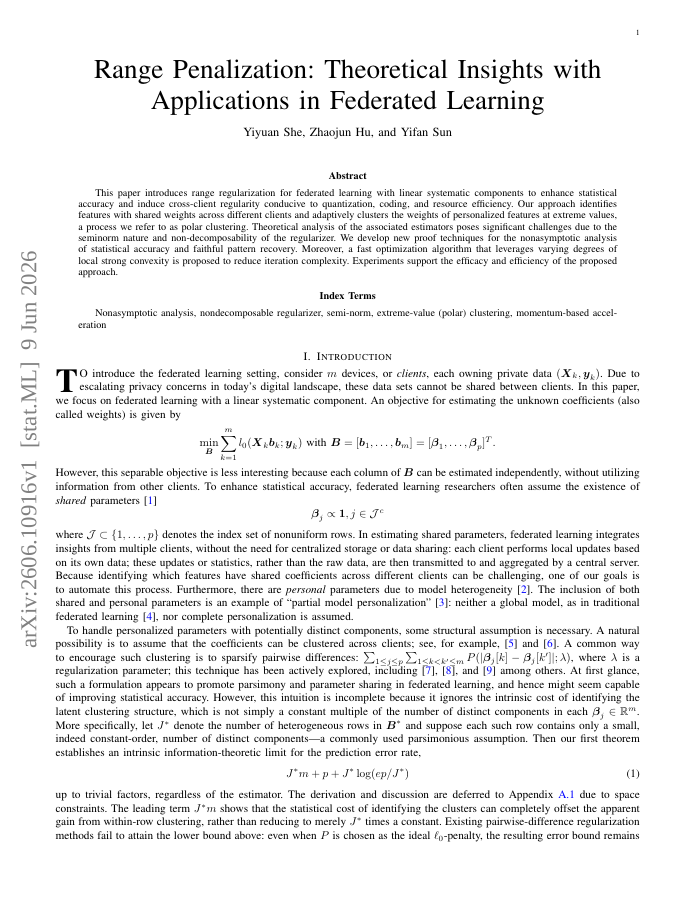
This paper introduces range regularization for federated learning with linear systematic components to enhance statistical accuracy and induce cross-client regularity conducive to quantization, coding, and resource efficiency. Our approach identifies features with shared weights across different clients and adaptively clusters the weights of personalized features at extreme values, a process we refer to as polar clustering. Theoretical analysis of the associated estimators poses significant challenges due to the seminorm nature and non-decomposability of the regularizer. We develop new proof techniques for the nonasymptotic analysis of statistical accuracy and faithful pattern recovery. Moreover, a fast optimization algorithm that leverages varying degrees of local strong convexity is proposed to reduce iteration complexity. Experiments support the efficacy and efficiency of the proposed approach.
Range Penalization: Theoretical Insights with Applications in Federated Learning
This paper introduces range regularization for federated learning with linear systematic components to enhance statistical accuracy and induce cross-client regularity conducive to quantization, coding, and resource efficiency.
- Preview
- Year
- 2026
- Hosting
- Full text hostedCC-BY-4.0
Cite
Notes
Only stored in your browser.
Attribution
- Abstract & full text
- arxiv.org/abs/2606.10916CC-BY-4.0
- TL;DR
- Semantic Scholar