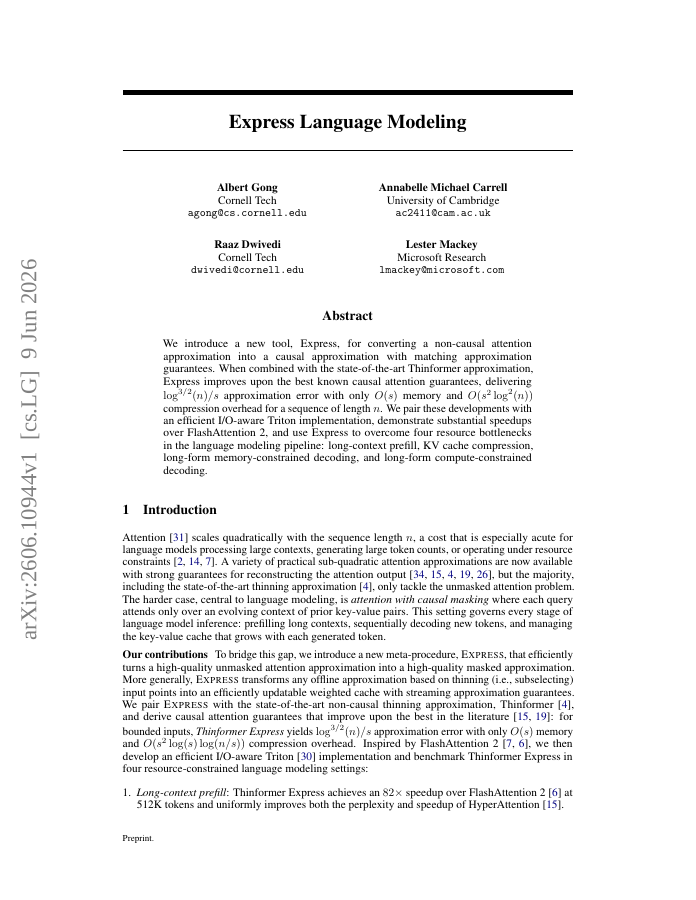
We introduce a new tool, Express, for converting a non-causal attention approximation into a causal approximation with matching approximation guarantees. When combined with the state-of-the-art Thinformer approximation, Express improves upon the best known causal attention guarantees, delivering \log^{3/2}(n)/s approximation error with only O(s) memory and O(s^2 \log^2(n)) compression overhead for a sequence of length n. We pair these developments with an efficient I/O-aware Triton implementation, demonstrate substantial speedups over FlashAttention 2, and use Express to overcome four resource bottlenecks in the language modeling pipeline: long-context prefill, KV cache compression, long-form memory-constrained decoding, and long-form compute-constrained decoding.
Express Language Modeling
We introduce a new tool, Express, for converting a non-causal attention approximation into a causal approximation with matching approximation guarantees. When combined with the state-of-the-art Thinformer approximation, Express improves upon the best known causal attention…
- Preview
- Year
- 2026
- Hosting
- Full text hostedCC-BY-4.0
Cite
Notes
Only stored in your browser.
Attribution
- Abstract & full text
- arxiv.org/abs/2606.10944CC-BY-4.0
- TL;DR
- Semantic Scholar