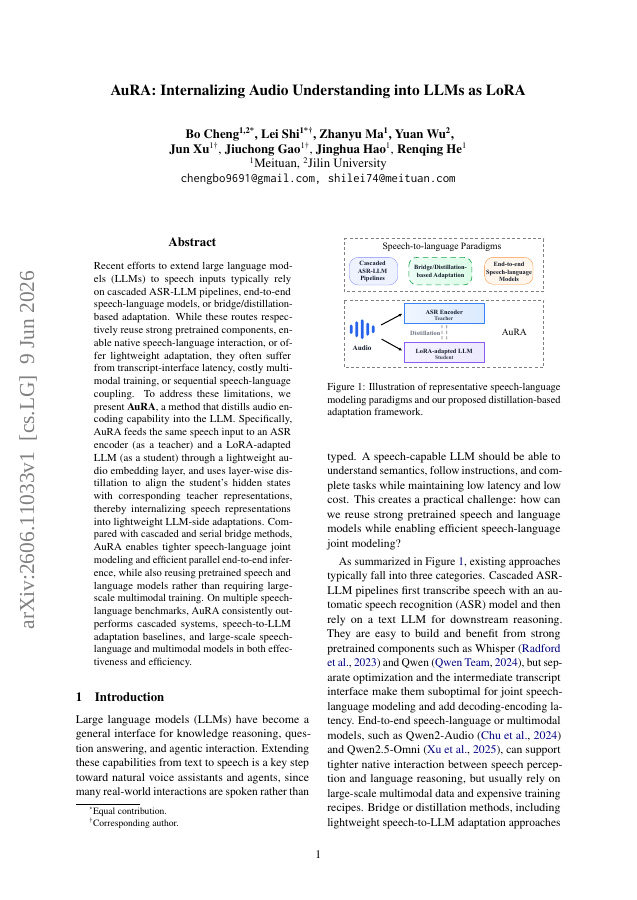
Recent efforts to extend large language models (LLMs) to speech inputs typically rely on cascaded ASR-LLM pipelines, end-to-end speech-language models, or bridge/distillation-based adaptation. While these routes respectively reuse strong pretrained components, enable native speech-language interaction, or offer lightweight adaptation, they often suffer from transcript-interface latency, costly multimodal training, or sequential speech-language coupling. To address these limitations, we present AuRA, a method that distills audio encoding capability into the LLM. Specifically, AuRA feeds the same speech input to an ASR encoder (as a teacher) and a LoRA-adapted LLM (as a student) through a lightweight audio embedding layer, and uses layer-wise distillation to align the student's hidden states with corresponding teacher representations, thereby internalizing speech representations into lightweight LLM-side adaptations. Compared with cascaded and serial bridge methods, AuRA enables tighter speech-language joint modeling and efficient parallel end-to-end inference, while also reusing pretrained speech and language models rather than requiring large-scale multimodal training. On multiple speech-language benchmarks, AuRA consistently outperforms cascaded systems, speech-to-LLM adaptation baselines, and large-scale speech-language and multimodal models in both effectiveness and efficiency.
AuRA: Internalizing Audio Understanding into LLMs as LoRA
Recent efforts to extend large language models (LLMs) to speech inputs typically rely on cascaded ASR-LLM pipelines, end-to-end speech-language models, or bridge/distillation-based adaptation.
- Preview
- Year
- 2026
- Hosting
- Abstract onlyARXIV-DEFAULT
Cite
Notes
Only stored in your browser.
Attribution
- Abstract & full text
- arxiv.org/abs/2606.11033ARXIV-DEFAULT
- TL;DR
- Semantic Scholar