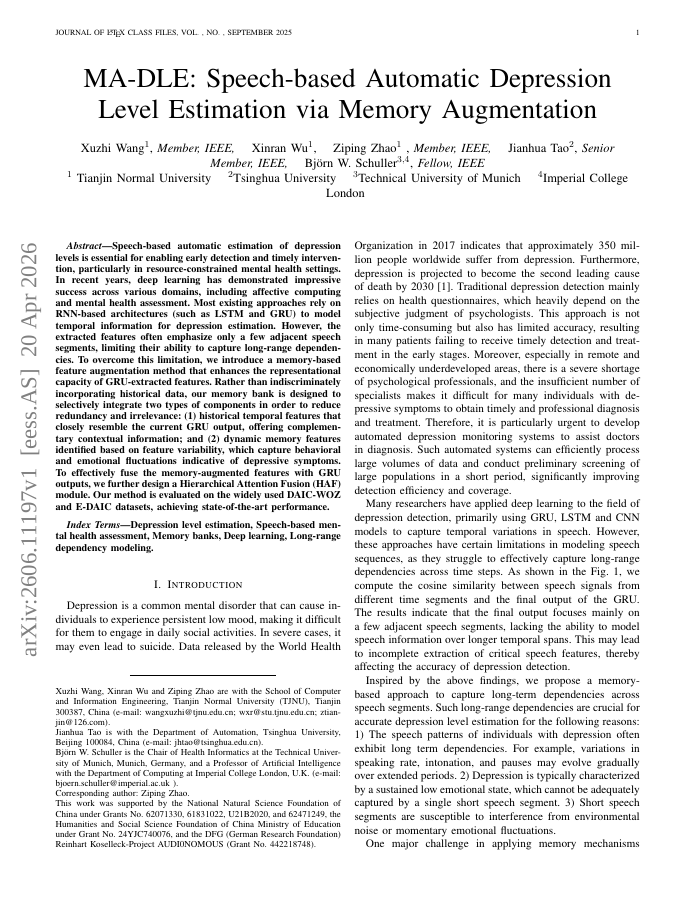
Speech-based automatic estimation of depression levels is essential for enabling early detection and timely intervention, particularly in resource-constrained mental health settings. In recent years, deep learning has demonstrated impressive success across various domains, including affective computing and mental health assessment. Most existing approaches rely on RNN-based architectures (such as LSTM and GRU) to model temporal information for depression estimation. However, the extracted features often emphasize only a few adjacent speech segments, limiting their ability to capture long-range dependencies. To overcome this limitation, we introduce a memory-based feature augmentation method that enhances the representational capacity of GRU-extracted features. Rather than indiscriminately incorporating historical data, our memory bank is designed to selectively integrate two types of components in order to reduce redundancy and irrelevance: (1) historical temporal features that closely resemble the current GRU output, offering complementary contextual information; and (2) dynamic memory features identified based on feature variability, which capture behavioral and emotional fluctuations indicative of depressive symptoms. To effectively fuse the memory-augmented features with GRU outputs, we further design a Hierarchical Attention Fusion (HAF) module. Our method is evaluated on the widely used DAIC-WOZ and E-DAIC datasets, achieving state-of-the-art performance.
MA-DLE: Speech-based Automatic Depression Level Estimation via Memory Augmentation
Speech-based automatic estimation of depression levels is essential for enabling early detection and timely intervention, particularly in resource-constrained mental health settings.
- Preview
- Year
- 2026
- Hosting
- Abstract onlyARXIV-DEFAULT
Cite
Notes
Only stored in your browser.
Attribution
- Abstract & full text
- arxiv.org/abs/2606.11197ARXIV-DEFAULT
- TL;DR
- Semantic Scholar