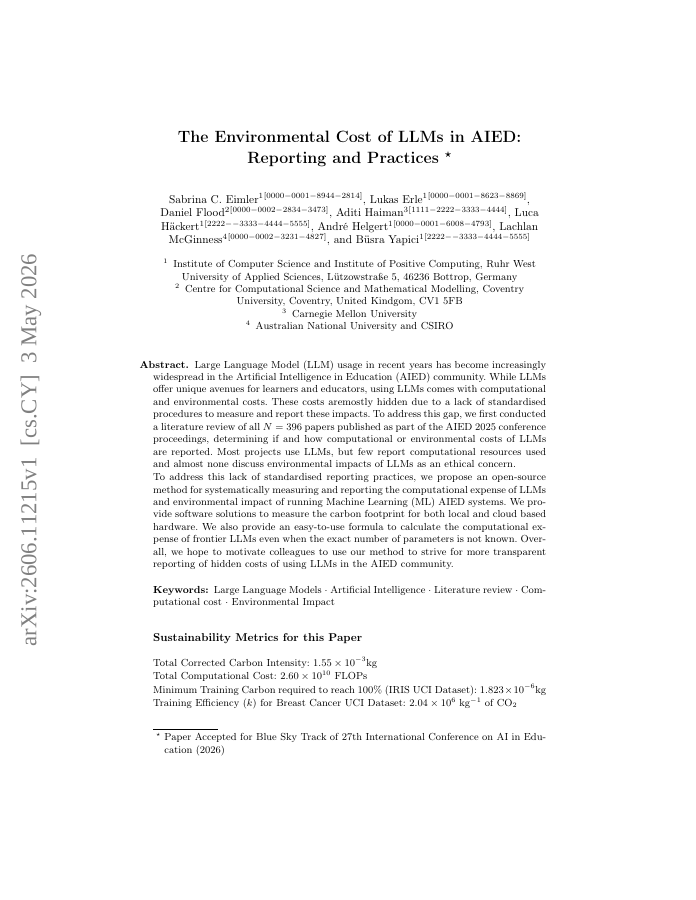
Large Language Model (LLM) usage in recent years has become increasingly widespread in the Artificial Intelligence in Education (AIED) community. While LLMs offer unique avenues for learners and educators, using LLMs comes with computational and environmental costs. These costs are mostly hidden due to a lack of standardised procedures to measure and report these impacts. To address this gap, we first conducted a literature review of all papers published as part of the AIED 2025 conference proceedings, determining if and how computational or environmental costs of LLMs are reported. Most projects use LLMs, but few report computational resources used and almost none discuss environmental impacts of LLMs as an ethical concern. To address this lack of standardised reporting practices, we propose an open-source method for systematically measuring and reporting the computational expense of LLMs and environmental impact of running Machine Learning (ML) AIED systems. We provide software solutions to measure the carbon footprint for both local and cloud based hardware. We also provide an easy-to-use formula to calculate the computational expense of frontier LLMs even when the exact number of parameters is not known. Overall, we hope to motivate colleagues to use our method to strive for more transparent reporting of hidden costs of using LLMs in the AIED community.
The Environmental Cost of LLMs in AIED: Reporting and Practices
Large Language Model (LLM) usage in recent years has become increasingly widespread in the Artificial Intelligence in Education (AIED) community. While LLMs offer unique avenues for learners and educators, using LLMs comes with computational and environmental costs.
- Preview
- Year
- 2026
- Hosting
- Full text hostedCC-BY-4.0
Cite
Notes
Only stored in your browser.
Attribution
- Abstract & full text
- arxiv.org/abs/2606.11215CC-BY-4.0
- TL;DR
- Semantic Scholar