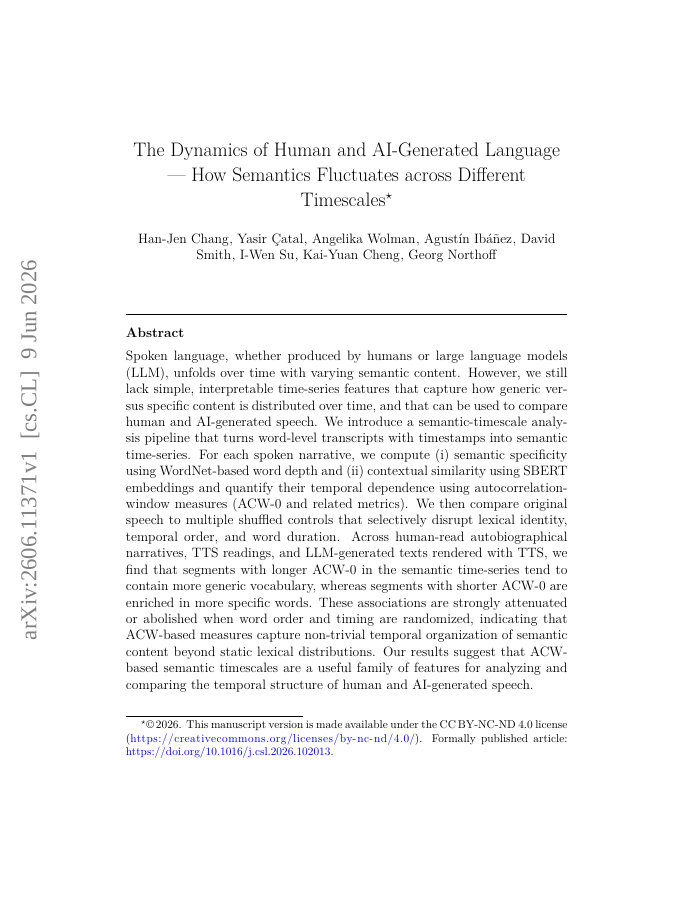
Spoken language, whether produced by humans or large language models (LLM), unfolds over time with varying semantic content. However, we still lack simple, interpretable time-series features that capture how generic versus specific content is distributed over time, and that can be used to compare human and AI-generated speech. We introduce a semantic-timescale analysis pipeline that turns word-level transcripts with timestamps into semantic time-series. For each spoken narrative, we compute (i) semantic specificity using WordNet-based word depth and (ii) contextual similarity using SBERT embeddings and quantify their temporal dependence using autocorrelation-window measures (ACW-0 and related metrics). We then compare original speech to multiple shuffled controls that selectively disrupt lexical identity, temporal order, and word duration. Across human-read autobiographical narratives, TTS readings, and LLM-generated texts rendered with TTS, we find that segments with longer ACW-0 in the semantic time-series tend to contain more generic vocabulary, whereas segments with shorter ACW-0 are enriched in more specific words. These associations are strongly attenuated or abolished when word order and timing are randomized, indicating that ACW-based measures capture non-trivial temporal organization of semantic content beyond static lexical distributions. Our results suggest that ACW-based semantic timescales are a useful family of features for analyzing and comparing the temporal structure of human and AI-generated speech.
The Dynamics of Human and AI-Generated Language: How Semantics Fluctuates across Different Timescales
Spoken language, whether produced by humans or large language models (LLM), unfolds over time with varying semantic content. However, we still lack simple, interpretable time-series features that capture how generic versus specific content is distributed over time, and that can…
- Preview
- Year
- 2026
- Hosting
- Excerpt onlyCC-BY-NC-4.0
Cite
Notes
Only stored in your browser.
Attribution
- Abstract & full text
- arxiv.org/abs/2606.11371CC-BY-NC-4.0
- TL;DR
- Semantic Scholar