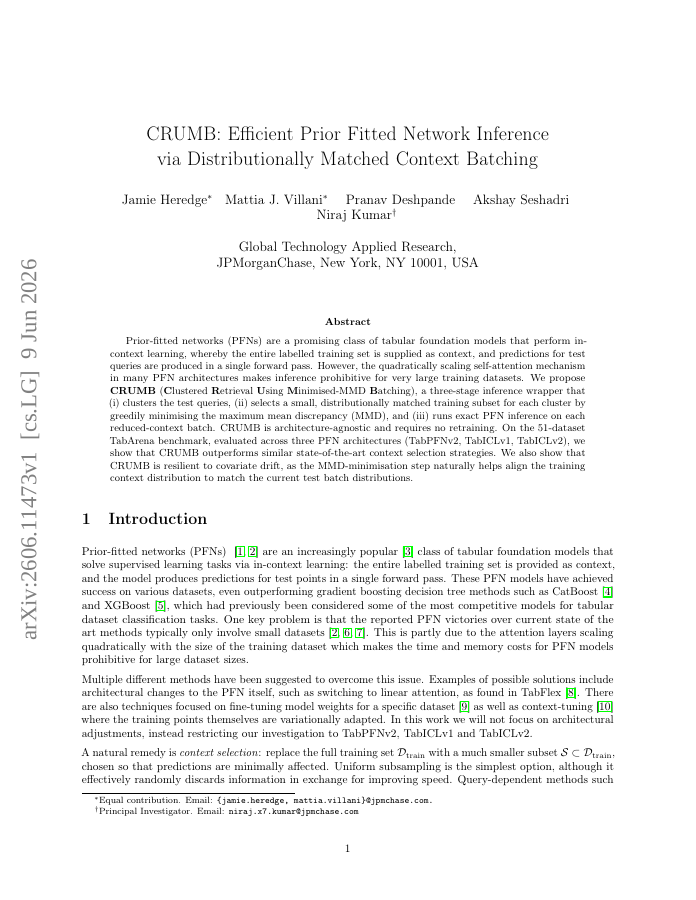
Prior-fitted networks (PFNs) are a promising class of tabular foundation models that perform in-context learning, whereby the entire labelled training set is supplied as context, and predictions for test queries are produced in a single forward pass. However, the quadratically scaling self-attention mechanism in many PFN architectures makes inference prohibitive for very large training datasets. We propose CRUMB (Clustered Retrieval Using Minimised-MMD Batching), a three-stage inference wrapper that (i) clusters the test queries, (ii) selects a small, distributionally matched training subset for each cluster by greedily minimising the maximum mean discrepancy (MMD), and (iii) runs exact PFN inference on each reduced-context batch. CRUMB is architecture-agnostic and requires no retraining. On the 51-dataset TabArena benchmark, evaluated across three PFN architectures (TabPFNv2, TabICLv1, TabICLv2), we show that CRUMB outperforms similar state-of-the-art context selection strategies. We also show that CRUMB is resilient to covariate drift, as the MMD-minimisation step naturally helps align the training context distribution to match the current test batch distributions.
CRUMB: Efficient Prior Fitted Network Inference via Distributionally Matched Context Batching
Prior-fitted networks (PFNs) are a promising class of tabular foundation models that perform in-context learning, whereby the entire labelled training set is supplied as context, and predictions for test queries are produced in a single forward pass.
- Preview
- Year
- 2026
- Hosting
- Full text hostedCC-BY-4.0
Cite
Notes
Only stored in your browser.
Attribution
- Abstract & full text
- arxiv.org/abs/2606.11473CC-BY-4.0
- TL;DR
- Semantic Scholar