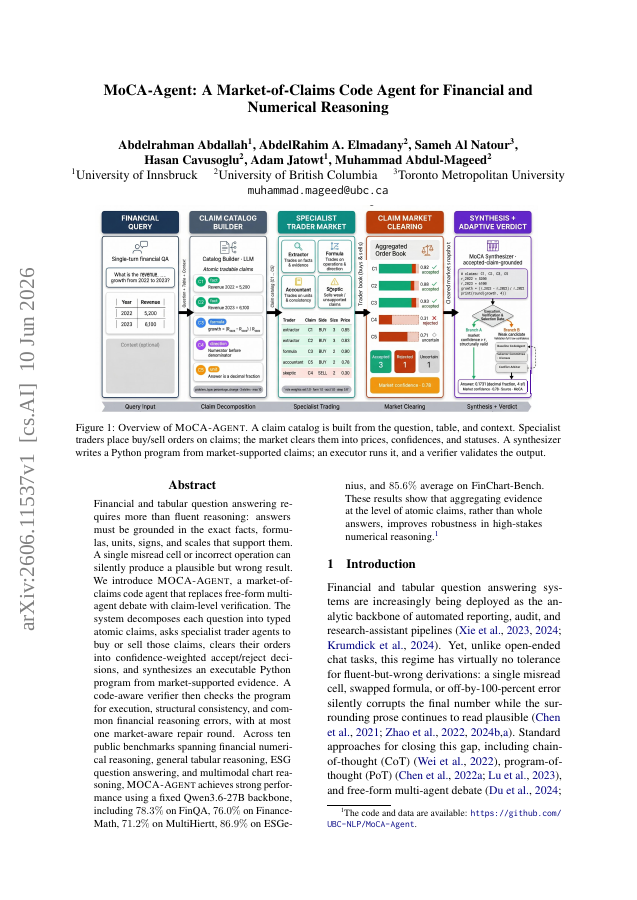
Financial and tabular question answering requires more than fluent reasoning: answers must be grounded in the exact facts, formulas, units, signs, and scales that support them. A single misread cell or incorrect operation can silently produce a plausible but wrong result. We introduce MOCA-Agent, a market-of-claims code agent that replaces free-form multi-agent debate with claim-level verification. The system decomposes each question into typed atomic claims, asks specialist trader agents to buy or sell those claims, clears their orders into confidence-weighted accept/reject decisions, and synthesizes an executable Python program from market-supported evidence. A code-aware verifier then checks the program for execution, structural consistency, and common financial reasoning errors, with at most one market-aware repair round. Across ten public benchmarks spanning financial numerical reasoning, general tabular reasoning, ESG question answering, and multimodal chart reasoning, MOCA-Agent achieves strong performance using a fixed Qwen3.6-27B backbone, including 78.3% on FinQA, 76.0% on FinanceMath, 71.2% on MultiHiertt, 86.9% on ESGenius, and 85.6% average on FinChart-Bench. These results show that aggregating evidence at the level of atomic claims, rather than whole answers, improves robustness in high-stakes numerical reasoning.\footnote{The code and data are available: https://github.com/UBC-NLP/MoCA-Agent.
MoCA-Agent: A Market-of-Claims Code Agent for Financial and Numerical Reasoning
Financial and tabular question answering requires more than fluent reasoning: answers must be grounded in the exact facts, formulas, units, signs, and scales that support them. A single misread cell or incorrect operation can silently produce a plausible but wrong result.
- Preview
- Year
- 2026
- Hosting
- Full text hostedCC-BY-4.0
Cite
Notes
Only stored in your browser.
Attribution
- Abstract & full text
- arxiv.org/abs/2606.11537CC-BY-4.0
- TL;DR
- Semantic Scholar