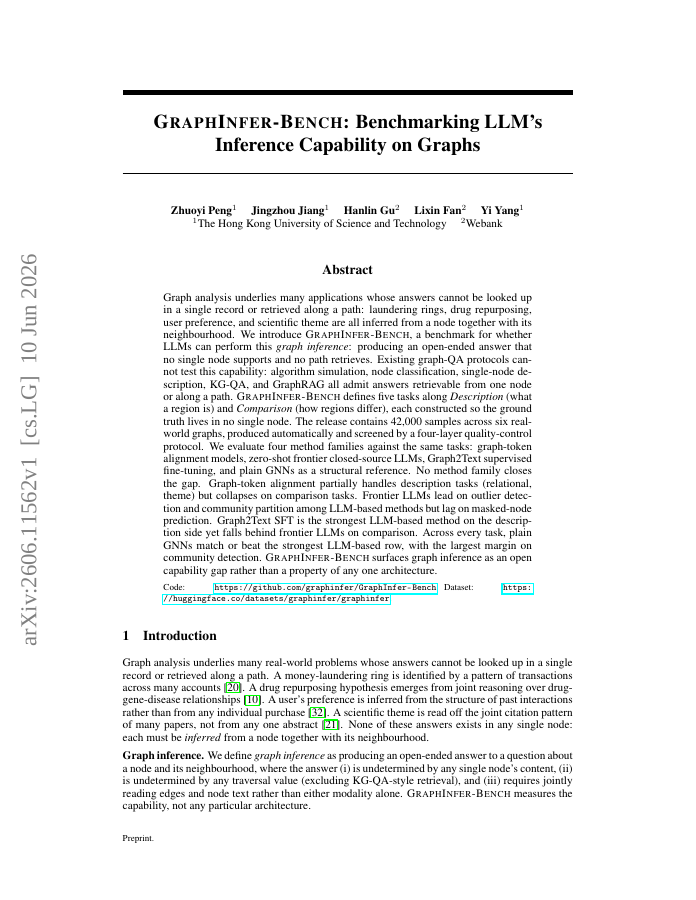
Graph analysis underlies many applications whose answers cannot be looked up in a single record or retrieved along a path: laundering rings, drug repurposing, user preference, and scientific theme are all inferred from a node together with its neighbourhood. We introduce GraphInfer-Bench, a benchmark for whether LLMs can perform this graph inference: producing an open-ended answer that no single node supports and no path retrieves. Existing graph-QA protocols cannot test this capability: algorithm simulation, node classification, single-node description, KG-QA, and GraphRAG all admit answers retrievable from one node or along a path. GraphInfer-Bench defines five tasks along Description (what a region is) and Comparison (how regions differ), each constructed so the ground truth lives in no single node. The release contains 42,000 samples across six real-world graphs, produced automatically and screened by a four-layer quality-control protocol. We evaluate four method families against the same tasks: graph-token alignment models, zero-shot frontier closed-source LLMs, Graph2Text supervised fine-tuning, and plain GNNs as a structural reference. No method family closes the gap. Graph-token alignment partially handles description tasks (relational, theme) but collapses on comparison tasks. Frontier LLMs lead on outlier detection and community partition among LLM-based methods but lag on masked-node prediction. Graph2Text SFT is the strongest LLM-based method on the description side yet falls behind frontier LLMs on comparison. Across every task, plain GNNs match or beat the strongest LLM-based row, with the largest margin on community detection. GraphInfer-Bench surfaces graph inference as an open capability gap rather than a property of any one architecture.
GraphInfer-Bench: Benchmarking LLM's Inference Capability on Graphs
Graph analysis underlies many applications whose answers cannot be looked up in a single record or retrieved along a path: laundering rings, drug repurposing, user preference, and scientific theme are all inferred from a node together with its neighbourhood.
- Preview
- Year
- 2026
- Hosting
- Full text hostedCC-BY-4.0
Cite
Notes
Only stored in your browser.
Attribution
- Abstract & full text
- arxiv.org/abs/2606.11562CC-BY-4.0
- TL;DR
- Semantic Scholar