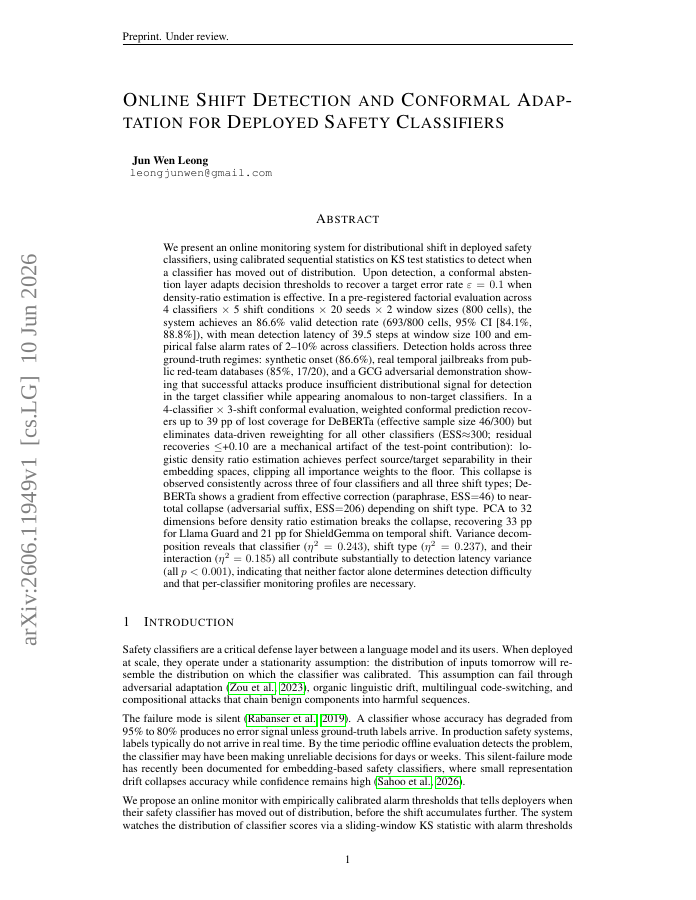
We present an online monitoring system for distributional shift in deployed safety classifiers, using calibrated sequential statistics to detect when a classifier has moved out of distribution. Upon detection, a conformal abstention layer adapts decision thresholds to recover a target error rate epsilon=0.1. In a pre-registered factorial evaluation (4 classifiers x 5 shift conditions x 20 seeds x 2 window sizes, 800 cells), the system achieves 86.6% valid detection (693/800, 95% CI [84.1%, 88.8%]) with mean latency of 39.5 steps. Detection holds across three ground-truth regimes: synthetic onset (86.6%), real temporal jailbreaks (85%, 17/20), and GCG adversarial attacks. Weighted conformal prediction recovers up to 39 pp of lost coverage for DeBERTa (ESS=46/300) but collapses for all other classifiers (ESS 300): logistic density ratio estimation achieves perfect source/target separability in high-dimensional embedding spaces, clipping all importance weights to the floor. DeBERTa shows a gradient from effective correction (paraphrase, ESS=46) to near-total collapse (adversarial suffix, ESS=206). PCA to 32 dimensions breaks the collapse, recovering 33 pp for Llama Guard and 21 pp for ShieldGemma. Variance decomposition reveals classifier (eta^2=0.243), shift type (eta^2=0.237), and their interaction (eta^2=0.185) all contribute substantially to detection latency variance (all p<0.001), indicating per-classifier monitoring profiles are necessary.
Online Shift Detection and Conformal Adaptation for Deployed Safety Classifiers
We present an online monitoring system for distributional shift in deployed safety classifiers, using calibrated sequential statistics to detect when a classifier has moved out of distribution.
- Preview
- Year
- 2026
- Hosting
- Full text hostedCC-BY-4.0
Cite
Notes
Only stored in your browser.
Attribution
- Abstract & full text
- arxiv.org/abs/2606.11949CC-BY-4.0
- TL;DR
- Semantic Scholar