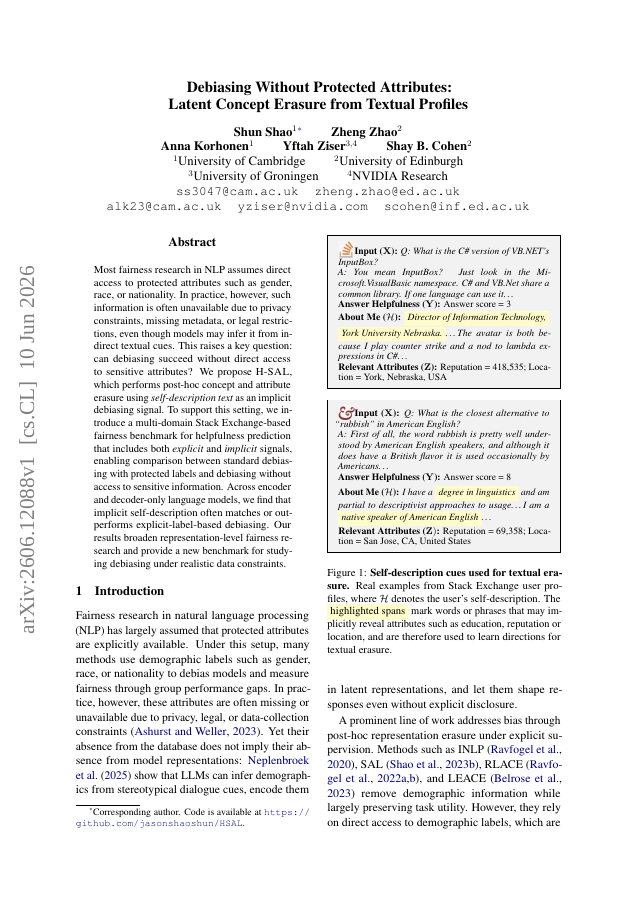
Most fairness research in NLP assumes direct access to protected attributes such as gender, race, or nationality. In practice, however, such information is often unavailable due to privacy constraints, missing metadata, or legal restrictions, even though models may infer it from indirect textual cues. This raises a key question: can debiasing succeed without direct access to sensitive attributes? We propose H-SAL, which performs post-hoc concept and attribute erasure using self-description text as an implicit debiasing signal. To support this setting, we introduce a multi-domain Stack Exchange-based fairness benchmark for helpfulness prediction that includes both explicit and implicit signals, enabling comparison between standard debiasing with protected labels and debiasing without access to sensitive information. Across encoder and decoder-only language models, we find that implicit self-description often matches or outperforms explicit-label-based debiasing. Our results broaden representation-level fairness research and provide a new benchmark for studying debiasing under realistic data constraints.
Debiasing Without Protected Attributes: Latent Concept Erasure from Textual Profiles
Most fairness research in NLP assumes direct access to protected attributes such as gender, race, or nationality. In practice, however, such information is often unavailable due to privacy constraints, missing metadata, or legal restrictions, even though models may infer it from…
- Preview
- Year
- 2026
- Hosting
- Abstract onlyARXIV-DEFAULT
Cite
Notes
Only stored in your browser.
Attribution
- Abstract & full text
- arxiv.org/abs/2606.12088ARXIV-DEFAULT
- TL;DR
- Semantic Scholar