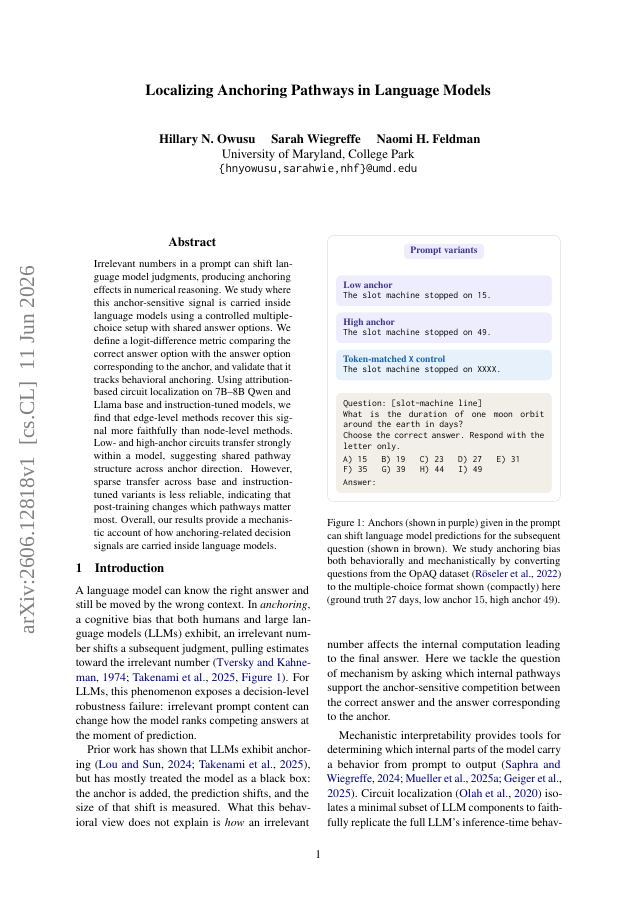
Irrelevant numbers in a prompt can shift language model judgments, producing anchoring effects in numerical reasoning. We study where this anchor-sensitive signal is carried inside language models using a controlled multiple-choice setup with shared answer options. We define a logit-difference metric comparing the correct answer option with the answer option corresponding to the anchor, and validate that it tracks behavioral anchoring. Using attribution-based circuit localization on 7B--8B Qwen and Llama base and instruction-tuned models, we find that edge-level methods recover this signal more faithfully than node-level methods. Low- and high-anchor circuits transfer strongly within a model, suggesting shared pathway structure across anchor direction. However, sparse transfer across base and instruction-tuned variants is less reliable, indicating that post-training changes which pathways matter most. Overall, our results provide a mechanistic account of how anchoring-related decision signals are carried inside language models.
Localizing Anchoring Pathways in Language Models
Irrelevant numbers in a prompt can shift language model judgments, producing anchoring effects in numerical reasoning. We study where this anchor-sensitive signal is carried inside language models using a controlled multiple-choice setup with shared answer options.
- Preview
- Year
- 2026
- Hosting
- Full text hostedCC-BY-4.0
Cite
Notes
Only stored in your browser.
Attribution
- Abstract & full text
- arxiv.org/abs/2606.12818CC-BY-4.0
- TL;DR
- Semantic Scholar