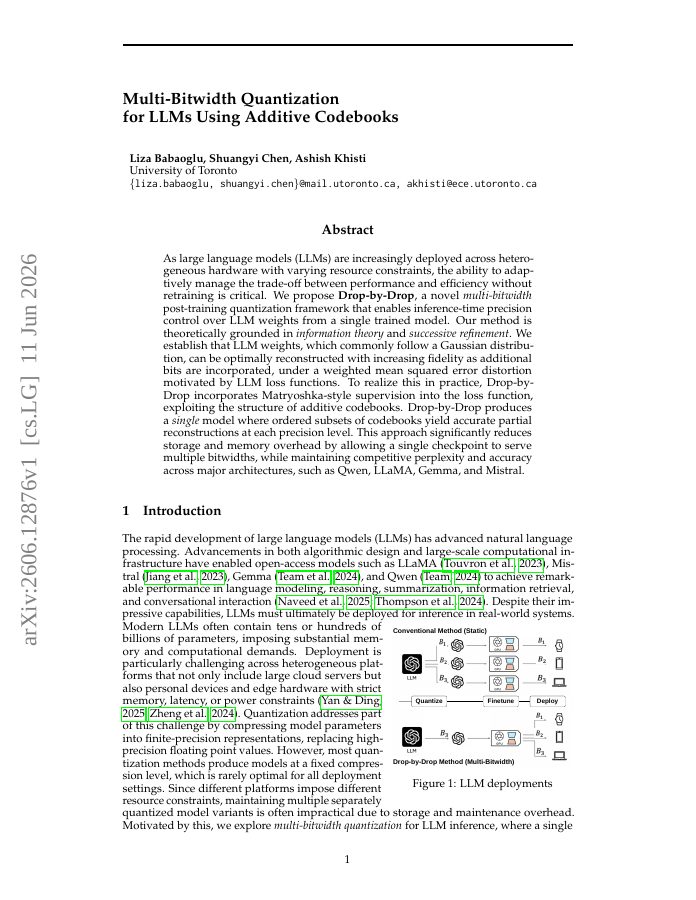
As large language models (LLMs) are increasingly deployed across heterogeneous hardware with varying resource constraints, the ability to adaptively manage the trade-off between performance and efficiency without retraining is critical. We propose Drop-by-Drop, a novel multi-bitwidth post-training quantization framework that enables inference-time precision control over LLM weights from a single trained model. Our method is theoretically grounded in information theory and successive refinement. We establish that LLM weights, which commonly follow a Gaussian distribution, can be optimally reconstructed with increasing fidelity as additional bits are incorporated, under a weighted mean squared error distortion motivated by LLM loss functions. To realize this in practice, Drop-by-Drop incorporates Matryoshka-style supervision into the loss function, exploiting the structure of additive codebooks. Drop-by-Drop produces a single model where ordered subsets of codebooks yield accurate partial reconstructions at each precision level. This approach significantly reduces storage and memory overhead by allowing a single checkpoint to serve multiple bitwidths, while maintaining competitive perplexity and accuracy across major architectures, such as Qwen, LLaMA, Gemma, and Mistral.
Multi-Bitwidth Quantization for LLMs Using Additive Codebooks
As large language models (LLMs) are increasingly deployed across heterogeneous hardware with varying resource constraints, the ability to adaptively manage the trade-off between performance and efficiency without retraining is critical.
- Preview
- Year
- 2026
- Hosting
- Full text hostedCC-BY-4.0
Cite
Notes
Only stored in your browser.
Attribution
- Abstract & full text
- arxiv.org/abs/2606.12876CC-BY-4.0
- TL;DR
- Semantic Scholar