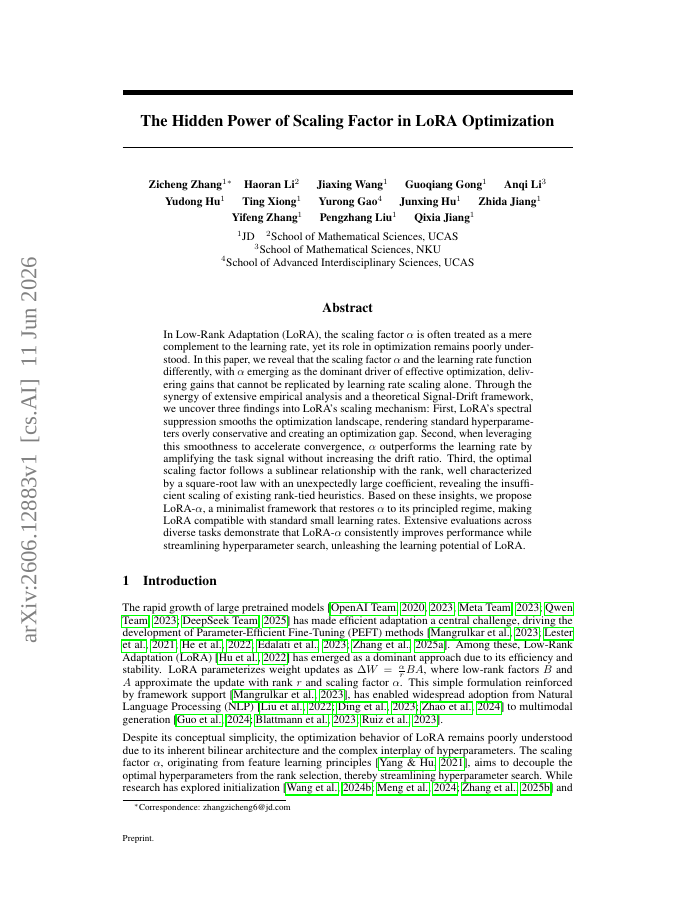
In Low-Rank Adaptation (LoRA), the scaling factor α is often treated as a mere complement to the learning rate, yet its role in optimization remains poorly understood. In this paper, we reveal that the scaling factor α and the learning rate function differently, with α emerging as the dominant driver of effective optimization, delivering gains that cannot be replicated by learning rate scaling alone. Through the synergy of extensive empirical analysis and a theoretical Signal-Drift framework, we uncover three findings into LoRA's scaling mechanism: First, LoRA's spectral suppression smooths the optimization landscape, rendering standard hyperparameters overly conservative and creating an optimization gap. Second, when leveraging this smoothness to accelerate convergence, α outperforms the learning rate by amplifying the task signal without increasing the drift ratio. Third, the optimal scaling factor follows a sublinear relationship with the rank, well characterized by a square-root law with an unexpectedly large coefficient, revealing the insufficient scaling of existing rank-tied heuristics. Based on these insights, we propose LoRA-α, a minimalist framework that restores α to its principled regime, making LoRA compatible with standard small learning rates. Extensive evaluations across diverse tasks demonstrate that LoRA-α consistently improves performance while streamlining hyperparameter search, unleashing the learning potential of LoRA.
The Hidden Power of Scaling Factor in LoRA Optimization
In Low-Rank Adaptation (LoRA), the scaling factor $α$ is often treated as a mere complement to the learning rate, yet its role in optimization remains poorly understood.
- Preview
- Year
- 2026
- Hosting
- Full text hostedCC-BY-4.0
Cite
Notes
Only stored in your browser.
Attribution
- Abstract & full text
- arxiv.org/abs/2606.12883CC-BY-4.0
- TL;DR
- Semantic Scholar