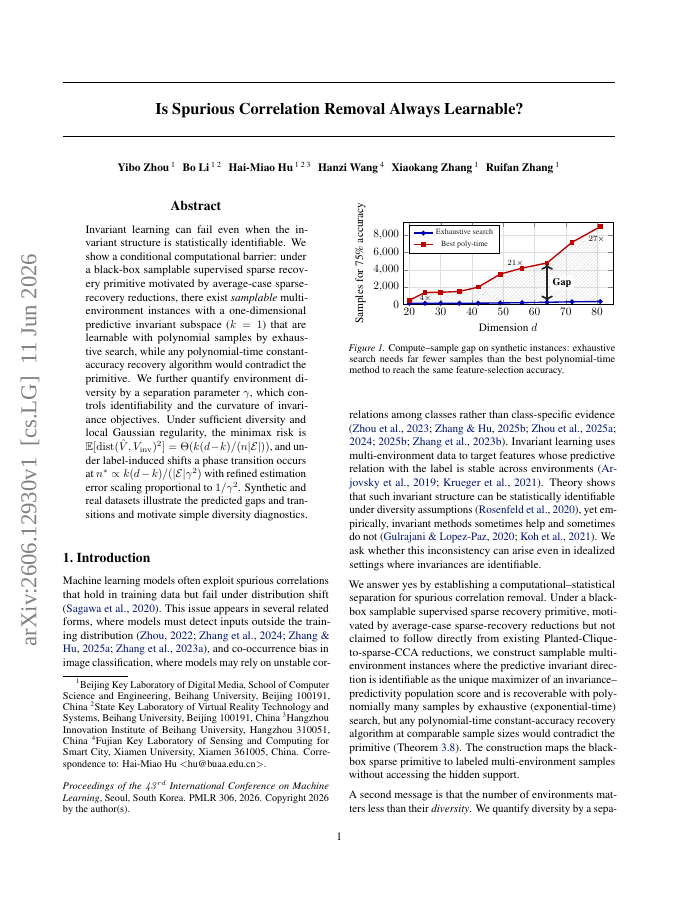
Invariant learning can fail even when the invariant structure is statistically identifiable. We show a conditional computational barrier: under a black-box samplable supervised sparse recovery primitive motivated by average-case sparse-recovery reductions, there exist samplable multi-environment instances with a one-dimensional predictive invariant subspace (k=1) that are learnable with polynomial samples by exhaustive search, while any polynomial-time constant-accuracy recovery algorithm would contradict the primitive. We further quantify environment diversity by a separation parameter γ, which controls identifiability and the curvature of invariance objectives. Under sufficient diversity and local Gaussian regularity, the minimax risk is \mathbb{E}[\dist(\hat{V},V_{inv})^2]=Θ(k(d-k)/(n|E|)), and under label-induced shifts a phase transition occurs at n^*\propto k(d-k)/(|E|γ^2) with refined estimation error scaling proportional to 1/γ^2. Synthetic and real datasets illustrate the predicted gaps and transitions and motivate simple diversity diagnostics.
Is Spurious Correlation Removal Always Learnable?
Invariant learning can fail even when the invariant structure is statistically identifiable. We show a conditional computational barrier: under a black-box samplable supervised sparse recovery primitive motivated by average-case sparse-recovery reductions, there exist…
- Preview
- Year
- 2026
- Hosting
- Full text hostedCC-BY-4.0
Cite
Notes
Only stored in your browser.
Attribution
- Abstract & full text
- arxiv.org/abs/2606.12930CC-BY-4.0
- TL;DR
- Semantic Scholar